

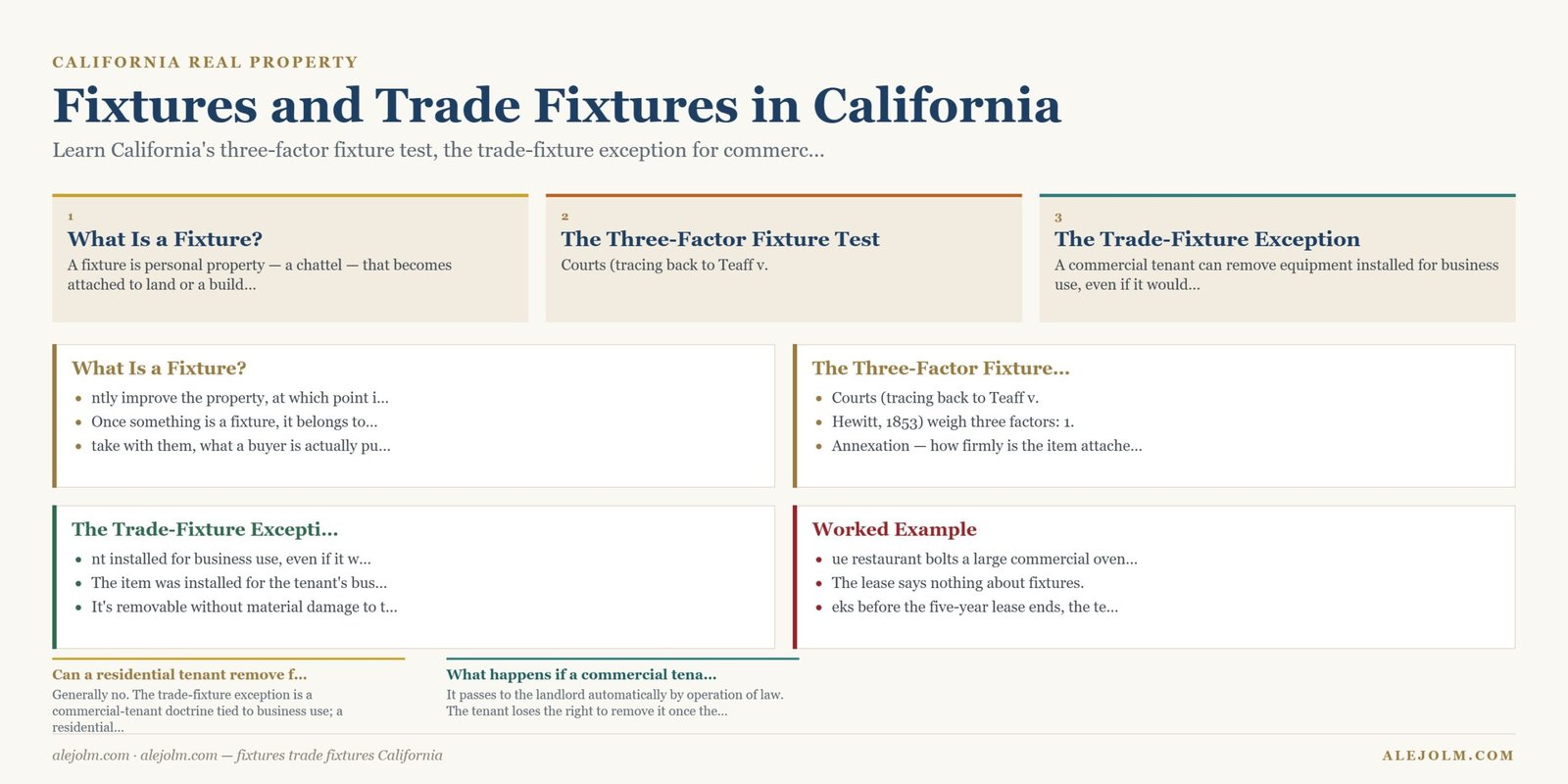
What Is a Fixture?
A fixture is personal property — a chattel — that becomes attached to land or a building in a way that objectively signals an intent to permanently improve the property, at which point it stops being personal property and becomes part of the real estate. Once something is a fixture, it belongs to the landowner or landlord, not whoever installed it.
This distinction matters enormously in practice: it decides what a departing tenant can take with them, what a buyer is actually purchasing, and what a lender’s mortgage collateral actually includes.
Fixture, defined in one sentence: a fixture is an item of personal property so attached to land that it is legally treated as part of the realty and passes with the property, unless a recognized exception — like the trade-fixture rule — applies.
The Three-Factor Fixture Test
Courts (tracing back to Teaff v. Hewitt, 1853) weigh three factors:
- Annexation — how firmly is the item attached, and how much damage would removal cause?
- Adaptation — is the item specifically fitted to this property (custom-built shelving, a built-in appliance)?
- Intent — what would a reasonable person infer about permanence from how the item was installed? This is an objective test, not the installer’s private intent.
Under California Civil Code § 660, an item is treated as annexed to realty when it’s affixed for permanent use — a codification of the common-law approach.
The Trade-Fixture Exception
A commercial tenant can remove equipment installed for business use, even if it would otherwise qualify as a fixture, if three conditions are met:
- The item was installed for the tenant’s business (not decorative or purely residential purposes);
- It’s removable without material damage to the property; and
- It’s removed before the lease ends.
That third condition is the trap that shows up constantly on exams and in real disputes: miss the deadline, and the fixture automatically passes to the landlord by operation of law — no separate lawsuit needed, no equitable exception.
| Fixture Type | Who It Belongs To | Removal Deadline |
|---|---|---|
| Ordinary fixture | Landlord/owner | N/A — never removable by tenant |
| Trade fixture | Tenant (if requirements met) | Must remove before lease ends |
| Trade fixture, not removed in time | Landlord | N/A — passes automatically |
Worked Example
A tenant operating a boutique restaurant bolts a large commercial oven and custom stainless-steel counters to the floor of a leased space. The lease says nothing about fixtures. Two weeks before the five-year lease ends, the tenant tells the landlord she intends to remove the oven and counters. The landlord objects, claiming they’re now part of the building.
Analysis: Apply the trade-fixture test. Business use? Yes — a commercial kitchen installation for a restaurant business. Removable without material damage? Likely yes, if unbolting doesn’t compromise the floor or structure — that’s a factual question the tenant should be ready to prove. Timing? Critical — she’s removing it before the lease ends, which satisfies the third requirement. If all three hold, she can take the oven and counters. Had she waited until after the lease expired to attempt removal, the equipment would have passed to the landlord automatically, regardless of how clearly it was installed for her business.
Express Lease Provisions Override Default Rules
A lease can simply define what counts as a fixture and what remains the tenant’s personal property, and that language controls over the default three-factor test. A well-drafted commercial lease will list specific items — “Tenant’s signage, kitchen equipment, and shelving are trade fixtures and may be removed by Tenant before lease end” — to avoid a costly dispute at move-out.
How Fixtures Interact With Mortgages and Title
A mortgage on real property typically covers “the land and all fixtures and improvements thereon” by default, so a foreclosure sale carries fixtures along with the land. A lender may specifically require certain items — built-in appliances, HVAC systems — to remain in place to protect the collateral’s value. On the buyer’s side, a purchaser should inspect the property to distinguish fixtures (which come with the sale) from items that remain the seller’s or tenant’s personal property.
In co-ownership situations, a fixture installed by one co-tenant generally becomes part of the co-owned property and benefits all co-tenants, unless it independently qualifies as a removable trade fixture installed for that co-tenant’s separate business use.
Common Mistakes to Avoid
- Missing the removal deadline. Trade fixtures not removed before lease termination pass to the landlord automatically — this is the single most tested trap.
- Applying the trade-fixture exception to residential tenants. It’s a commercial-use doctrine; a residential tenant’s chandelier or built-in shelving doesn’t qualify.
- Treating intent as subjective. The test asks what a reasonable observer would conclude, not what the installer privately intended.
- Ignoring express lease language. A lease clause defining fixture status controls over the default three-factor test.
FAQ
Can a residential tenant remove fixtures they installed?
Generally no. The trade-fixture exception is a commercial-tenant doctrine tied to business use; a residential tenant’s installed items typically pass to the landlord as ordinary fixtures.
What happens if a commercial tenant forgets to remove a trade fixture before the lease ends?
It passes to the landlord automatically by operation of law. The tenant loses the right to remove it once the lease terminates, even if it was clearly installed for the tenant’s business.
Does a lease need to say anything about fixtures for the default rules to apply?
No — if the lease is silent, courts apply the three-factor test (annexation, adaptation, intent). But an express clause defining fixture status will override the default rules.
Key Takeaways
- Fixture status turns on annexation, adaptation, and intent, measured objectively.
- Fixtures generally belong to the landlord/owner by default once installed.
- The trade-fixture exception lets commercial tenants remove business equipment if it’s removable without material damage and taken before the lease ends.
- Missing the removal deadline means the item automatically becomes the landlord’s property.
- Express lease language defining fixtures overrides the default common-law test.
This article is educational and is not legal advice. Consult a licensed California attorney about your situation.
Related guides
- tenant duties under a California lease
- assignment vs. sublease rules
- licenses vs. easements in California