
Assignment vs. Sublease: The Basic Difference
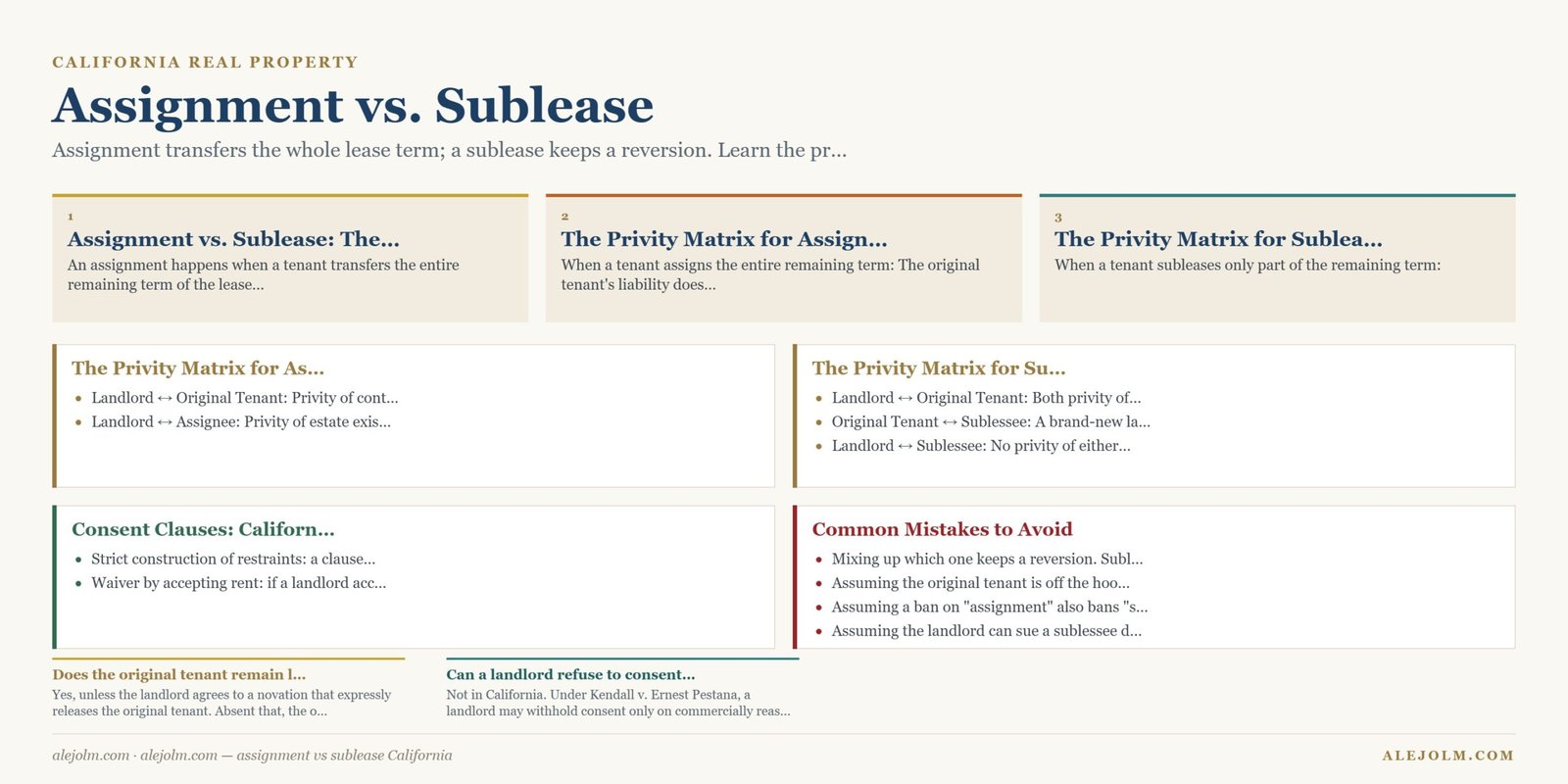
An assignment happens when a tenant transfers the entire remaining term of the lease, keeping nothing. A sublease happens when a tenant transfers only part of the remaining term, retaining a reversionary interest. That one distinction — whole term versus partial term — drives everything else: who’s liable to whom, and who the landlord can sue.
This is one of the most heavily tested privity topics on the California Bar Exam, and it’s also a real trap for commercial tenants trying to exit a lease early without understanding what they’re actually signing up for.
Assignment vs. sublease, defined in one sentence: an assignment transfers a tenant’s entire remaining lease term to a new party (creating privity of estate between landlord and assignee), while a sublease transfers only part of the term (leaving the original tenant fully liable and creating no direct relationship between landlord and sublessee).
The Privity Matrix for Assignment
When a tenant assigns the entire remaining term:
- Landlord ↔ Original Tenant: Privity of contract survives — the original lease promises remain in force, and the original tenant stays secondarily liable. Privity of estate is gone.
- Landlord ↔ Assignee: Privity of estate exists — the assignee is primarily liable for covenants that run with the land (rent, repair, fixture removal). Privity of contract does not exist unless the assignee expressly assumes the lease.
The original tenant’s liability doesn’t just evaporate after assigning. It continues unless the landlord agrees to a novation — an explicit substitution that releases the original tenant entirely. Absent a novation, the landlord can pursue either the assignee (primary liability) or the original tenant (secondary liability), or both.
The Privity Matrix for Sublease
When a tenant subleases only part of the remaining term:
- Landlord ↔ Original Tenant: Both privity of estate and privity of contract remain intact — the original tenant is fully liable, full stop.
- Original Tenant ↔ Sublessee: A brand-new landlord-tenant relationship forms between them.
- Landlord ↔ Sublessee: No privity of either kind. The landlord has no direct claim against the sublessee and must sue the original tenant, who then pursues the sublessee.
| Relationship | Assignment | Sublease |
|---|---|---|
| Landlord ↔ Original Tenant | Privity of contract only | Privity of contract + estate |
| Landlord ↔ Transferee | Privity of estate only | None |
| Landlord can sue transferee directly? | Yes | No |
Worked Example
Lisa has 10 years remaining on a 15-year commercial lease. She transfers the entire remaining 10 years to Fast Bites Inc. Six months later, Fast Bites stops paying rent. Who can the landlord, Omar, sue?
Analysis: This is an assignment — Lisa retained nothing. Fast Bites is in privity of estate with Omar and is primarily liable for rent. Lisa remains in privity of contract and is secondarily liable, since Omar never agreed to a novation releasing her. Omar can sue either or both Fast Bites and Lisa. If Lisa ends up paying, she can then seek indemnity from Fast Bites.
Now change the facts: Lisa transfers only 5 of her remaining 10 years to Fast Bites, keeping the last 5 years for herself. This is a sublease. Fast Bites has no direct relationship with Omar at all. If Fast Bites stops paying, Omar’s only recourse is against Lisa (who remains fully liable under the original lease), and Lisa must separately pursue Fast Bites.
Consent Clauses: California’s Rule
Many leases require landlord consent before an assignment or sublease. California’s landmark case, Kendall v. Ernest Pestana, Inc. (1985), holds that where a lease requires consent to assign, the landlord may withhold consent only on commercially reasonable grounds — creditworthiness, proposed use, financial stability. Personal prejudice or arbitrary refusal isn’t enough.
Two related rules matter just as much:
- Strict construction of restraints: a clause banning “assignment” does not automatically bar a “sublease.” Courts construe restraints on alienation narrowly. Only a clause expressly prohibiting both will do so.
- Waiver by accepting rent: if a landlord accepts rent directly from an assignee with knowledge of the transfer, the landlord waives any objection to it.
How Assignment and Sublease Interact With Co-Ownership and Mortgages
If co-tenants A and B each own a share of the leased property and A wants to assign A’s landlord interest, whether B’s consent is required depends on the co-ownership arrangement and applicable law. On the tenant side, if A and B hold a leasehold as joint tenants and A assigns A’s interest to C, that assignment severs the joint tenancy — C becomes a tenant in common with B, though B’s consent isn’t required for the assignment itself.
Mortgages add another layer: many mortgages require the tenant to subordinate the leasehold to the mortgage, meaning foreclosure can terminate the lease depending on priority. Some mortgages also require lender consent before an assignment or sublease, to protect the property as collateral.
Common Mistakes to Avoid
- Mixing up which one keeps a reversion. Sublease keeps a reversionary interest for the original tenant; assignment keeps nothing.
- Assuming the original tenant is off the hook after assigning. They remain secondarily liable absent a novation.
- Assuming a ban on “assignment” also bans “sublease.” Courts construe these narrowly — say both if you mean both.
- Assuming the landlord can sue a sublessee directly. There’s no privity between landlord and sublessee; the landlord must go through the original tenant.
FAQ
Does the original tenant remain liable after assigning the lease?
Yes, unless the landlord agrees to a novation that expressly releases the original tenant. Absent that, the original tenant remains secondarily liable in privity of contract even after an assignment.
Can a landlord refuse to consent to an assignment for any reason?
Not in California. Under Kendall v. Ernest Pestana, a landlord may withhold consent only on commercially reasonable grounds, not personal preference or arbitrary refusal.
If my lease bars “assignment,” am I also barred from subleasing?
No, generally. Courts strictly construe restraints on alienation, so a clause prohibiting only “assignment” does not automatically prohibit a “sublease” unless the lease says so explicitly.
Key Takeaways
- Assignment = entire remaining term transferred; sublease = only part of the term, with a reversion retained.
- After an assignment, the assignee is in privity of estate (primary liability) and the original tenant stays in privity of contract (secondary liability) absent a novation.
- A sublessee has no direct legal relationship with the landlord — the landlord must sue the original tenant.
- California’s Kendall v. Pestana limits a landlord’s ability to withhold consent to commercially reasonable grounds only.
- A restriction on “assignment” does not automatically restrict “sublease” — courts read these narrowly.
This article is educational and is not legal advice. Consult a licensed California attorney about your situation.
Related guides
- tenant duties under a California lease
- landlord duties in California
- fixtures and trade fixtures explained