
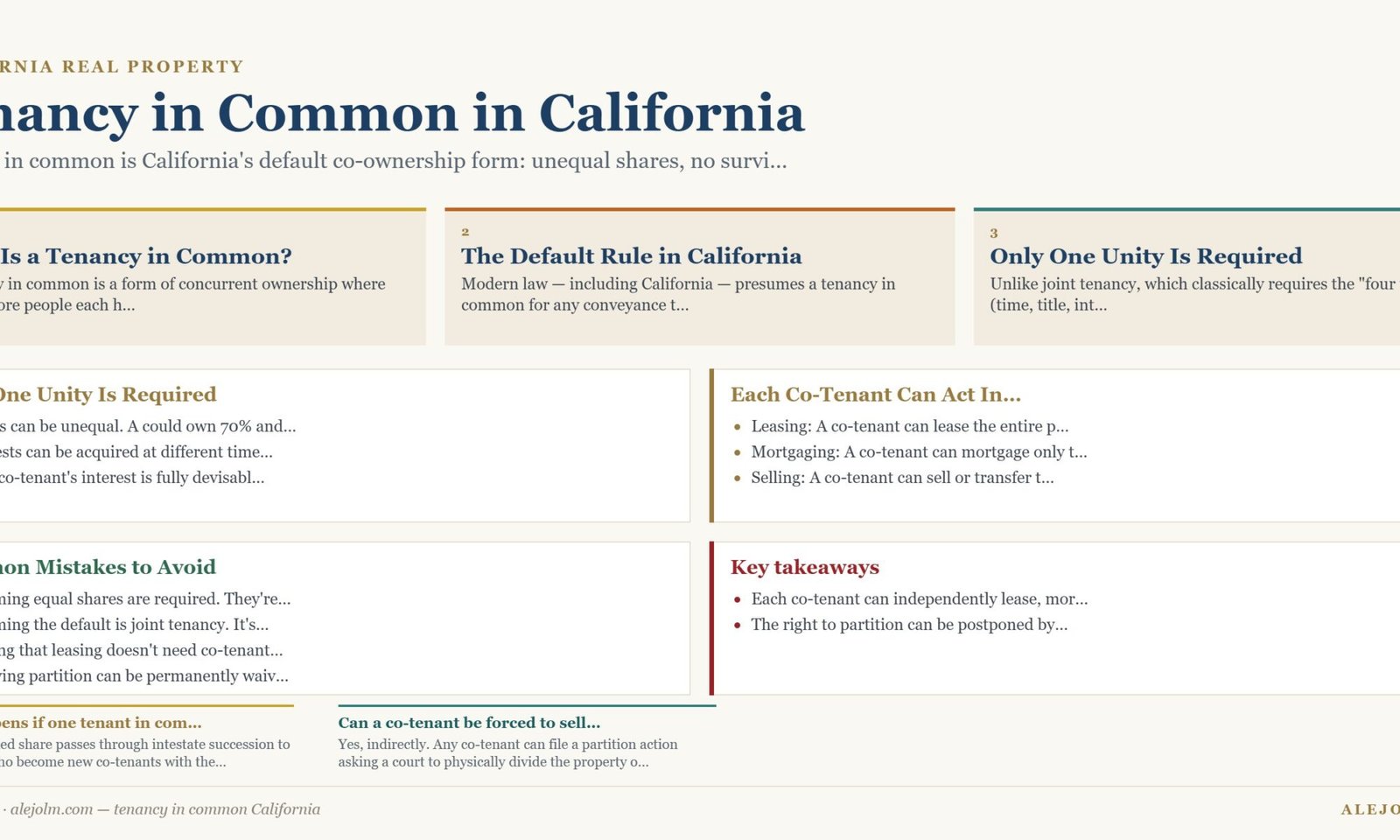
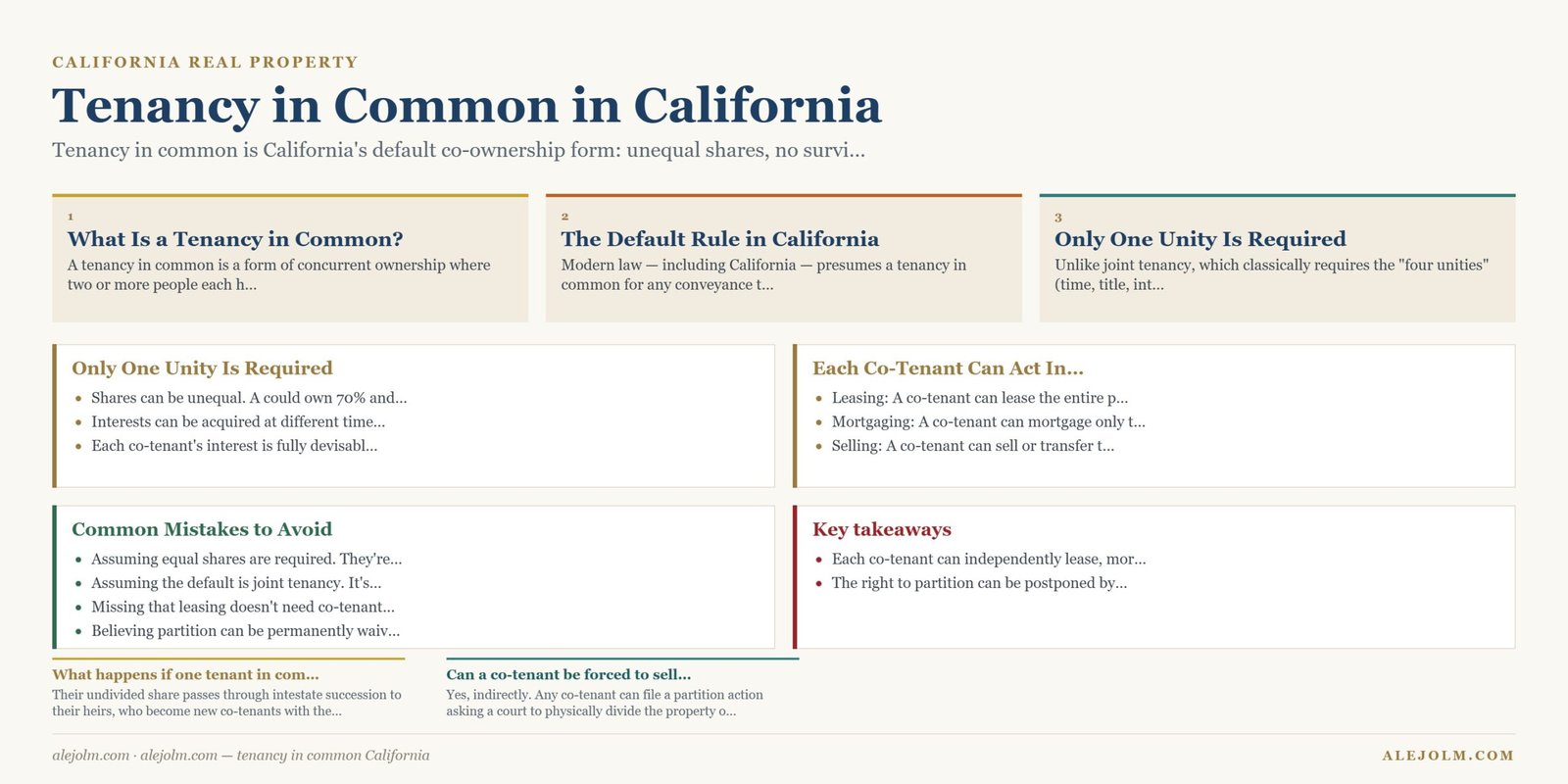
What Is a Tenancy in Common?
A tenancy in common is a form of concurrent ownership where two or more people each hold an undivided interest in the whole property, with an equal right to possess it, and no right of survivorship. When a co-tenant dies, their share passes through their will or by intestate succession — not automatically to the surviving co-owners.
This matters far beyond the bar exam. Siblings who inherit a house together, business partners who buy a building, or unmarried couples who purchase a home typically end up as tenants in common, often without realizing what that means for what happens when one of them dies, wants out, or stops paying their share.
Tenancy in common, defined in one sentence: it’s concurrent land ownership where each co-owner holds an undivided (possibly unequal) share with full possessory rights over the whole, freely transferable and inheritable, with no automatic passing of a deceased owner’s share to the others.
The Default Rule in California
Modern law — including California — presumes a tenancy in common for any conveyance to two or more unmarried people, unless the deed uses explicit survivorship language. A grant “to A and B” creates a tenancy in common. Only a grant “to A and B as joint tenants with right of survivorship” creates a joint tenancy.
California’s Supreme Court confirmed this in Tenhet v. Boswell (1976): without express survivorship language, a tenancy in common arises by default, not a joint tenancy.
Only One Unity Is Required
Unlike joint tenancy, which classically requires the “four unities” (time, title, interest, and possession), a tenancy in common requires only the unity of possession — each co-tenant has the right to possess the whole property. That single requirement makes tenancy in common flexible:
- Shares can be unequal. A could own 70% and B 30%, and both remain valid tenants in common.
- Interests can be acquired at different times and by different instruments.
- Each co-tenant’s interest is fully devisable, descendible, and alienable.
What Happens on Death
This is where tenancy in common diverges sharply from joint tenancy, and it’s the single most tested distinction.
| Feature | Tenancy in Common | Joint Tenancy |
|---|---|---|
| Survivorship | None | Yes — automatic |
| Shares | Can be unequal | Must be equal |
| Unities required | Possession only | Time, title, interest, possession |
| On death, interest passes to | Heirs/devisees | Surviving joint tenants |
If Husband and Wife hold Blackacre as tenants in common and Husband dies, Wife does not automatically inherit the whole property. Husband’s half passes through his estate to his heirs or devisees. Wife now co-owns the property with whoever inherited Husband’s share — a new co-tenant, not necessarily a family member Wife knows well.
Each Co-Tenant Can Act Independently
A tenancy in common lets each owner deal with their own share without needing the other co-tenants’ consent — a rule that surprises a lot of people.
- Leasing: A co-tenant can lease the entire property to a third party without the other co-tenant’s permission. The tenant’s possession isn’t adverse to the non-leasing co-tenant, but the rent belongs to both co-tenants, who must account to each other for their share.
- Mortgaging: A co-tenant can mortgage only their own undivided interest. If Lender forecloses, Lender steps into that co-tenant’s shoes and becomes a co-tenant with the others — not the sole owner.
- Selling: A co-tenant can sell or transfer their interest freely, without consent, subject to normal recording-act priority rules for whoever records first.
Worked Example
Marcus and Priya buy a duplex together as tenants in common, with Marcus contributing 65% of the purchase price and Priya 35%. Their deed reflects this split. Two years later, Marcus, without telling Priya, leases the entire duplex to a tenant, Devon, for $3,000/month. Priya finds out and objects that she never consented.
Analysis: Marcus’s lease to Devon is valid — a co-tenant can lease the whole property without the other co-tenant’s consent. Devon’s possession isn’t adverse to Priya because it flows through Marcus’s lawful right to possess the whole. Priya’s remedy isn’t to evict Devon; it’s an accounting. Priya is entitled to 35% of the rental income Marcus collects. If Marcus refuses to pay, Priya can sue for an accounting and, if the relationship has broken down entirely, seek partition.
The Right to Partition
Any tenant in common can force a partition — either a physical division of the property or a court-ordered sale with proceeds divided by ownership share. Under California Code of Civil Procedure § 872.210 and related sections, partition actions are how co-owners resolve disputes when they can’t agree on selling, buying each other out, or continuing to co-own.
Critically, the right to partition cannot be permanently waived. Co-tenants may agree to postpone partition for a defined, reasonable period, but courts won’t enforce a permanent bar on partition.
Contribution Rights
If one co-tenant pays property taxes, mortgage payments, insurance, or necessary repairs, that co-tenant can seek contribution from the others for their proportional share. This right is frequently overlooked but comes up constantly in real disputes between family members or ex-partners who co-own property.
Common Mistakes to Avoid
- Assuming equal shares are required. They’re not — unequal fractional interests are fully valid.
- Assuming the default is joint tenancy. It’s the opposite; tenancy in common is the default absent explicit survivorship language.
- Missing that leasing doesn’t need co-tenant consent. The non-consenting co-tenant’s remedy is an accounting, not eviction of the tenant.
- Believing partition can be permanently waived. It can only be postponed for a limited, reasonable time.
FAQ
What happens if one tenant in common dies without a will?
Their undivided share passes through intestate succession to their heirs, who become new co-tenants with the surviving owner(s). It does not pass automatically to the other co-tenant.
Can a co-tenant be forced to sell their share?
Yes, indirectly. Any co-tenant can file a partition action asking a court to physically divide the property or order a sale, with proceeds split by ownership percentage.
Does a co-tenant need permission from the others to rent out the property?
No. A co-tenant may lease the entire property without consent from other co-owners, though the leasing co-tenant must account to the others for their share of the rent collected.
Key Takeaways
- California presumes tenancy in common for conveyances to unmarried co-owners absent explicit survivorship language.
- Only the unity of possession is required; shares can be unequal.
- There is no right of survivorship — a deceased co-tenant’s share passes through their estate.
- Each co-tenant can independently lease, mortgage, or sell their own share.
- The right to partition can be postponed by agreement but never permanently waived.
This article is educational and is not legal advice. Consult a licensed California attorney about your situation.
Related guides
- equitable servitudes and CC&Rs in California
- landlord duties under California law
- assignment vs. sublease rules