
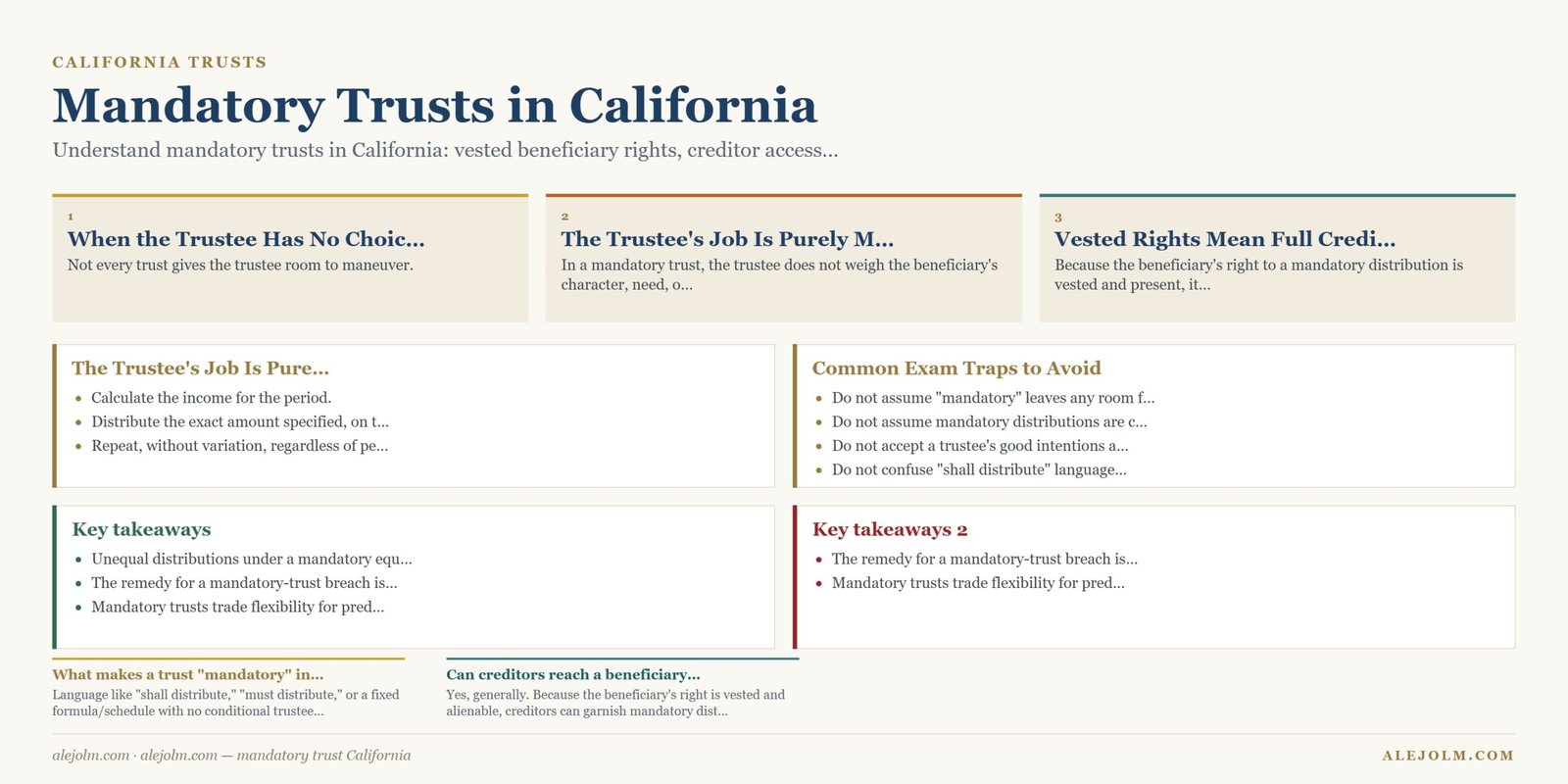
When the Trustee Has No Choice: Understanding Mandatory Trusts
Not every trust gives the trustee room to maneuver. A mandatory trust strips out discretion entirely: the trust instrument fixes the amount and timing of distributions, and the trustee’s only job is to follow the instructions exactly. For California Bar Exam purposes, mandatory trusts are the easiest category to analyze — but that simplicity hides a trap, because “easy law” is exactly where careless students lose points on breach and creditor questions.
A mandatory trust requires the trustee to make distributions to beneficiaries according to fixed terms set out in the trust instrument, with no discretion over whether to distribute or how much. The beneficiary’s right to the specified distribution is vested and enforceable the moment the trust terms call for it.
The Trustee’s Job Is Purely Ministerial
In a mandatory trust, the trustee does not weigh the beneficiary’s character, need, or financial responsibility. If the instrument says “trustee shall distribute all net income to my daughter Claire quarterly,” the trustee’s task is arithmetic and administrative, not judgmental:
- Calculate the income for the period.
- Distribute the exact amount specified, on the exact schedule specified.
- Repeat, without variation, regardless of personal opinion about Claire’s spending habits.
A trustee cannot withhold a mandatory distribution because they believe the beneficiary will misuse the money, is going through a divorce, or has a substance abuse problem. Those are precisely the concerns that justify a discretionary or support trust instead — but once the settlor chose mandatory language, the trustee has no room to substitute judgment.
Vested Rights Mean Full Creditor Exposure
Because the beneficiary’s right to a mandatory distribution is vested and present, it is also fully alienable. That has real consequences:
- The beneficiary can assign the right to a third party.
- The beneficiary can pledge the expected distribution as loan collateral.
- A judgment creditor can garnish the distribution without waiting for the trustee to exercise any discretion, because there is none to exercise.
This is the opposite of a discretionary trust, where creditors must wait for an actual distribution decision. In a mandatory trust, the vested right itself is property the creditor can reach — unless the trust instrument includes a spendthrift clause, which restrains both voluntary assignment and most involuntary creditor attachment (subject to California’s statutory carve-outs for child support, spousal support, and other priority claims).
The Classic Breach Scenario: Unequal Distributions
Bar essays love a fact pattern where a mandatory trust requires equal treatment of multiple beneficiaries, and the trustee deviates — often for a sympathetic-sounding reason. The rule is unforgiving: if the trust mandates equal distributions and the trustee distributes unequally without a basis stated in the trust document, that is a breach, full stop.
Courts will not let a trustee justify unequal mandatory distributions on policy grounds like “I gave my nephew less because he struggles with alcohol and I wanted to protect him.” Good intentions do not cure a mandatory-trust breach. Each shortchanged beneficiary can sue and recover the shortfall through the surcharge remedy — a personal money judgment against the trustee equal to the loss, potentially with prejudgment interest and attorneys’ fees.
| Trust Duty Standard | Trustee’s Role | Beneficiary’s Remedy for Non-Compliance |
|---|---|---|
| Mandatory | Ministerial — distribute exactly as directed | Sue for breach; recover surcharge for shortfall |
| Discretionary | Judgment call — may distribute or withhold | Sue only for abuse of discretion (bad faith, dishonesty, unreasonableness) |
| Support (HEMS) | Bounded judgment — must meet health/education/maintenance/support needs | Sue if trustee fails to meet the objective HEMS standard |
A Worked Bar Exam Hypo
Trust instrument: “Trustee shall distribute one-third of net trust income, in equal shares, to each of my three children — Ana, Ben, and Cora — quarterly for their lives.” In the first quarter, the trustee distributes $9,000 to Ana, $9,000 to Ben, and only $3,000 to Cora, explaining privately that Cora “already has enough money from her own job.”
Walk through the analysis:
- Is this a mandatory trust? Yes — “shall distribute,” in fixed equal shares, on a fixed schedule, with no conditioning language.
- Did the trustee comply? No. Equal shares were required, and Cora received one-third of what her siblings received.
- Is the trustee’s justification (Cora “has enough”) a defense? No. A mandatory trust gives the trustee no authority to consider a beneficiary’s independent resources; that consideration belongs to support or discretionary trusts, not mandatory ones.
- Remedy: Cora can sue for breach of trust and recover a surcharge equal to her $6,000 shortfall, and the trustee has no valid defense.
Why Settlors Choose Mandatory Trusts
Mandatory trusts fit situations where the settlor wants predictable, guaranteed distributions with zero trustee interference — for instance, a fixed income stream to a surviving spouse, or equal treatment guaranteed among children regardless of a future trustee’s personal views. The tradeoff is that the settlor gives up flexibility: a mandatory trust cannot adapt if a beneficiary later develops a drug problem, faces a lawsuit, or simply doesn’t need the money. That flexibility gap is exactly why estate planners often pair mandatory income interests with discretionary principal powers in the same trust instrument.
Common Exam Traps to Avoid
- Do not assume “mandatory” leaves any room for trustee judgment about amount, timing, or beneficiary conduct — it does not.
- Do not assume mandatory distributions are creditor-protected by default; only a valid spendthrift clause changes that.
- Do not accept a trustee’s good intentions as a defense to an unequal or delayed mandatory distribution.
- Do not confuse “shall distribute” language (mandatory) with “may distribute” language (discretionary) — courts read this distinction strictly.
FAQ
What makes a trust “mandatory” instead of discretionary?
Language like “shall distribute,” “must distribute,” or a fixed formula/schedule with no conditional trustee judgment creates a mandatory trust. If the instrument uses “may” or gives the trustee judgment over amount or timing, it is discretionary instead.
Can creditors reach a beneficiary’s interest in a mandatory trust?
Yes, generally. Because the beneficiary’s right is vested and alienable, creditors can garnish mandatory distributions unless the trust contains a valid spendthrift clause that restrains such claims.
What happens if a trustee distributes unequal amounts under a mandatory equal-distribution trust?
That is a breach of trust. Any beneficiary who received less than their mandated share can sue the trustee and recover the shortfall through the surcharge remedy, regardless of the trustee’s reasons.
Key Takeaways
- A mandatory trust requires the trustee to distribute exact amounts on a fixed schedule, with no discretion over whether or how much.
- The beneficiary’s right is vested and enforceable, making it fully alienable and generally reachable by creditors absent a spendthrift clause.
- Unequal distributions under a mandatory equal-share trust are a classic, unexcused breach — good intentions are not a defense.
- The remedy for a mandatory-trust breach is surcharge: a personal judgment against the trustee for the beneficiary’s loss.
- Mandatory trusts trade flexibility for predictability, which is why they are often combined with discretionary provisions in real estate planning.
This article is educational and is not legal advice. Consult a licensed California attorney about your situation.