
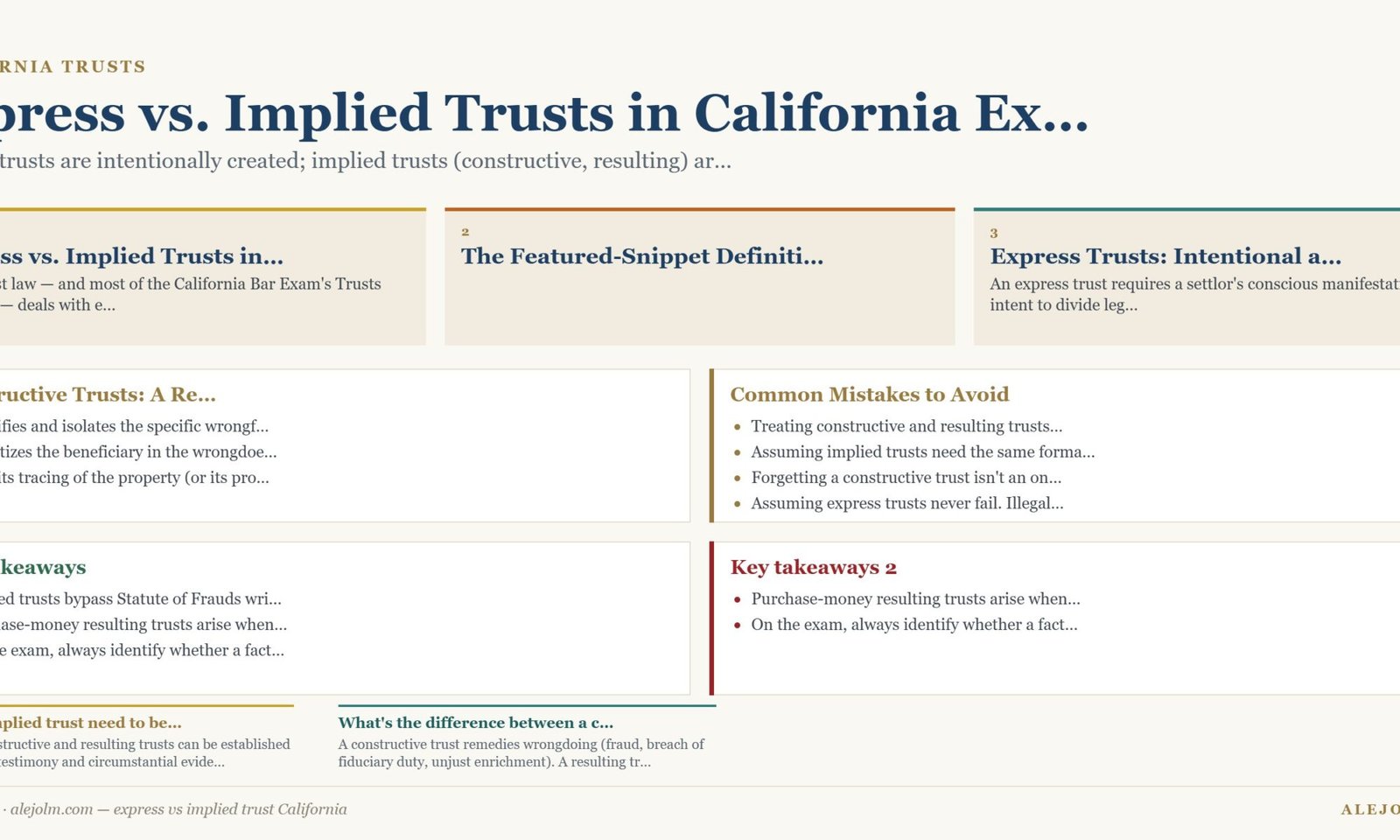

Express vs. Implied Trusts in California
Most trust law — and most of the California Bar Exam’s Trusts coverage — deals with express trusts: the ones someone actually sat down and created on purpose. But California courts also impose trusts that nobody intended, as a remedy for fraud, mistake, or unjust enrichment. Knowing when a court will do that, and why, is essential for both exam analysis and real-world litigation over disputed property.
The dividing line is intent. Express trusts exist because a settlor manifested intent to create one. Implied trusts exist despite the absence of that intent, because equity demands a remedy.
The Featured-Snippet Definition
An express trust is intentionally created by a settlor’s manifestation of intent, through a deed, declaration, or will provision. An implied trust — constructive or resulting — is imposed by a court as an equitable remedy, with no manifestation of settlor intent required. Constructive trusts remedy wrongdoing; resulting trusts correct a failed or incomplete express trust.
Express Trusts: Intentional and Formal
An express trust requires a settlor’s conscious manifestation of intent to divide legal and equitable ownership and bind a trustee to fiduciary duties. That intent can come from a written deed of trust, a sufficiently clear oral declaration, or a testamentary provision in a will. Courts test intent objectively: would a reasonable observer, looking at the settlor’s words and conduct, understand that a trust was intended?
Express trusts are the default and the primary mechanism for planned wealth transfer — most bar exam Trusts essays, and nearly every California living trust drafted by an estate planning attorney, are express trusts.
Constructive Trusts: A Remedy, Not a Trust
A constructive trust is an equitable remedy, not a true trust in the administrative sense. Courts impose it when property has been wrongfully or fraudulently obtained or retained — for example, when a fiduciary misappropriates trust assets, or when someone procures property through fraud, breach of confidential relationship, or undue influence.
Because it’s a remedy, a constructive trust does the following:
- Identifies and isolates the specific wrongfully held property.
- Prioritizes the beneficiary in the wrongdoer’s bankruptcy, ahead of general unsecured creditors.
- Permits tracing of the property (or its proceeds) even after it’s been moved or commingled.
A person seeking a constructive trust must prove wrongdoing, identify the specific property, and connect the wrongdoing to that property with clear and convincing evidence.
Resulting Trusts: Correcting an Incomplete Transfer
A resulting trust arises when an express trust fails or becomes impossible, or when the circumstances of a purchase suggest the true beneficial owner is someone other than the person on title. Equitable title “results” back to whoever actually intended to hold the beneficial interest — often the settlor’s estate or the person who supplied the purchase money.
Two common scenarios trigger a resulting trust:
- Failed express trust. A settlor transfers property to a trustee for an illegal or impossible purpose; the trust fails, and a resulting trust sends the property back to the settlor’s estate.
- Purchase-money resulting trust. Property is titled in one person’s name but paid for by another; equity presumes the buyer intended the titleholder to hold it for the buyer’s benefit, absent evidence of a gift.
Comparing the Three Trust Types
| Type | How It Arises | Purpose |
|---|---|---|
| Express trust | Settlor’s manifested intent (deed, declaration, will) | Planned wealth transfer and management |
| Constructive trust | Court-imposed remedy for wrongdoing | Prevent unjust enrichment; recover misappropriated property |
| Resulting trust | Court-imposed correction for a failed transfer | Return equitable title to the true intended owner |
Why Formality Requirements Differ
Express trusts of real property require a writing under California’s Statute of Frauds; express trusts of personal property can be oral if intent is clear. Implied trusts sidestep formal requirements almost entirely — a constructive or resulting trust claim over land can proceed without a writing, proven instead by clear and convincing evidence, sometimes bolstered by doctrines like part performance or estoppel.
Worked Example
Priya lends her sister Anjali $80,000 to buy a condo in San Diego, but the deed is recorded in Anjali’s name alone because Priya was traveling abroad during escrow. There’s no written trust document and no gift language. Because Priya supplied the purchase money and the circumstances don’t suggest a gift, a court can impose a purchase-money resulting trust, holding that Anjali holds legal title for Priya’s benefit.
Contrast that with a separate case: Anjali, acting as trustee of a family trust, secretly diverts $20,000 of trust funds into her personal account. Because Anjali breached her fiduciary duty and wrongfully retained trust property, a court would instead impose a constructive trust over the diverted funds (or their traceable proceeds) in favor of the trust’s actual beneficiaries.
Common Mistakes to Avoid
- Treating constructive and resulting trusts as interchangeable. Constructive trusts remedy wrongdoing; resulting trusts correct a failure or mistake. They serve different functions even though both are “implied.”
- Assuming implied trusts need the same formalities as express trusts. They don’t — oral evidence and part performance can establish an implied trust even over real property.
- Forgetting a constructive trust isn’t an ongoing fiduciary relationship. It’s a one-time restitutionary device to recover specific property, not a trust with trustee duties going forward.
- Assuming express trusts never fail. Illegal purposes, impossible conditions, or a predeceasing beneficiary with no heirs can all cause an express trust to fail, triggering a resulting trust.
FAQ
Does an implied trust need to be in writing?
No. Both constructive and resulting trusts can be established through oral testimony and circumstantial evidence, even for real property, because they arise by operation of law rather than through the Statute of Frauds.
What’s the difference between a constructive trust and a resulting trust?
A constructive trust remedies wrongdoing (fraud, breach of fiduciary duty, unjust enrichment). A resulting trust corrects a failed or incomplete express trust, or reflects who actually supplied the money for a purchase, without requiring any wrongdoing.
Can a court impose a constructive trust even if the wrongdoer acted in good faith?
Generally, constructive trusts require some form of wrongdoing, fraud, or breach of a confidential or fiduciary relationship — good-faith conduct alone typically won’t support the remedy, though breach of fiduciary duty doesn’t require bad intent.
Key Takeaways
- Express trusts require the settlor’s manifested intent; implied trusts (constructive and resulting) require none.
- Constructive trusts remedy wrongdoing and unjust enrichment; resulting trusts correct failed or incomplete transfers.
- Implied trusts bypass Statute of Frauds writing requirements, provable instead by clear and convincing evidence.
- Purchase-money resulting trusts arise when one person pays for property titled in another’s name without gift intent.
- On the exam, always identify whether a fact pattern shows intentional creation (express) or a wrongdoing/failure scenario (implied) first.
This article is educational and is not legal advice. Consult a licensed California attorney about your situation.
Related guides
- Trust Creation: Intent Element
- What Is a Trust in California? Roles, Rules & Types
- Legal vs. Equitable Title in a California Trust Explained
- Undue Influence in California Wills