
Does Getting Divorced Automatically Change Your Will in California?
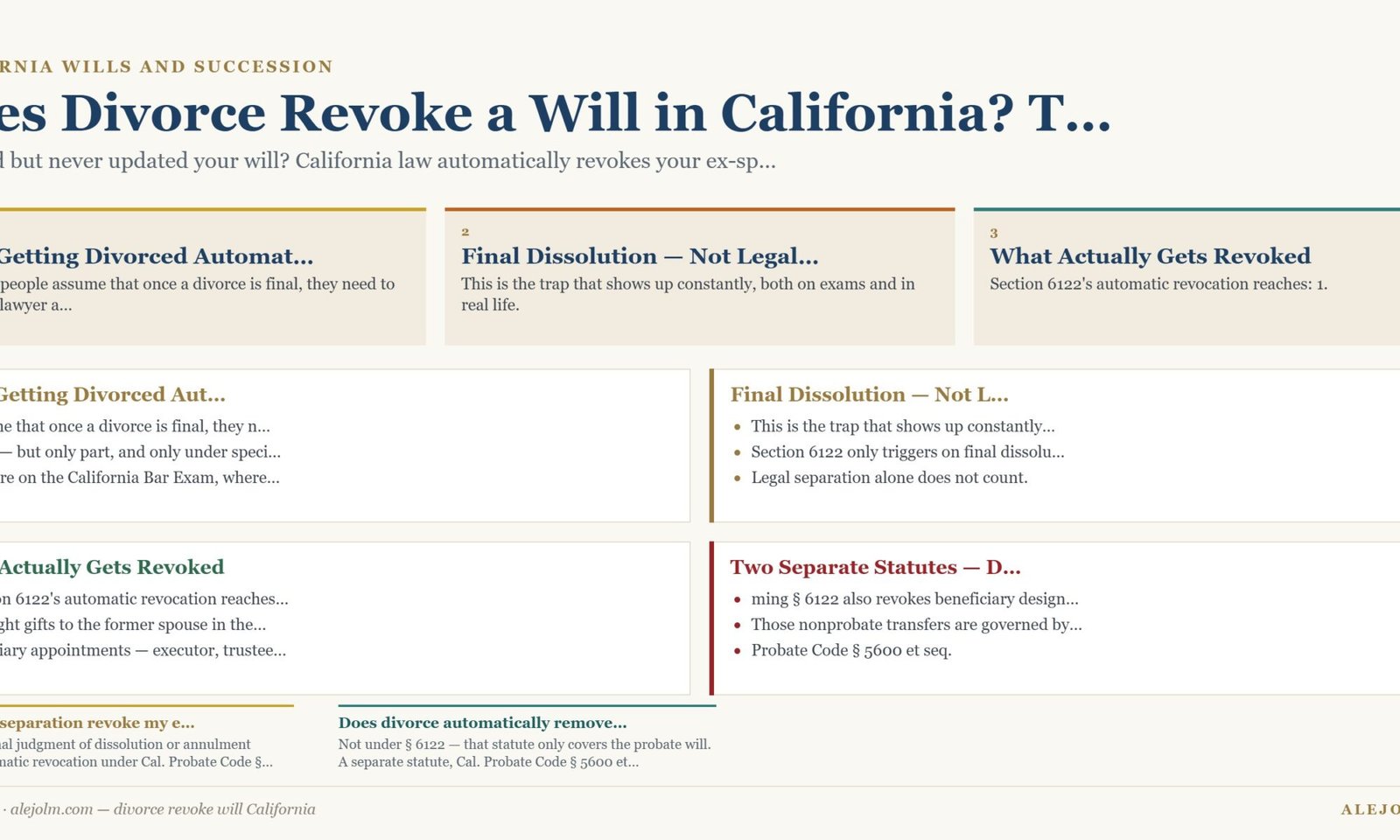
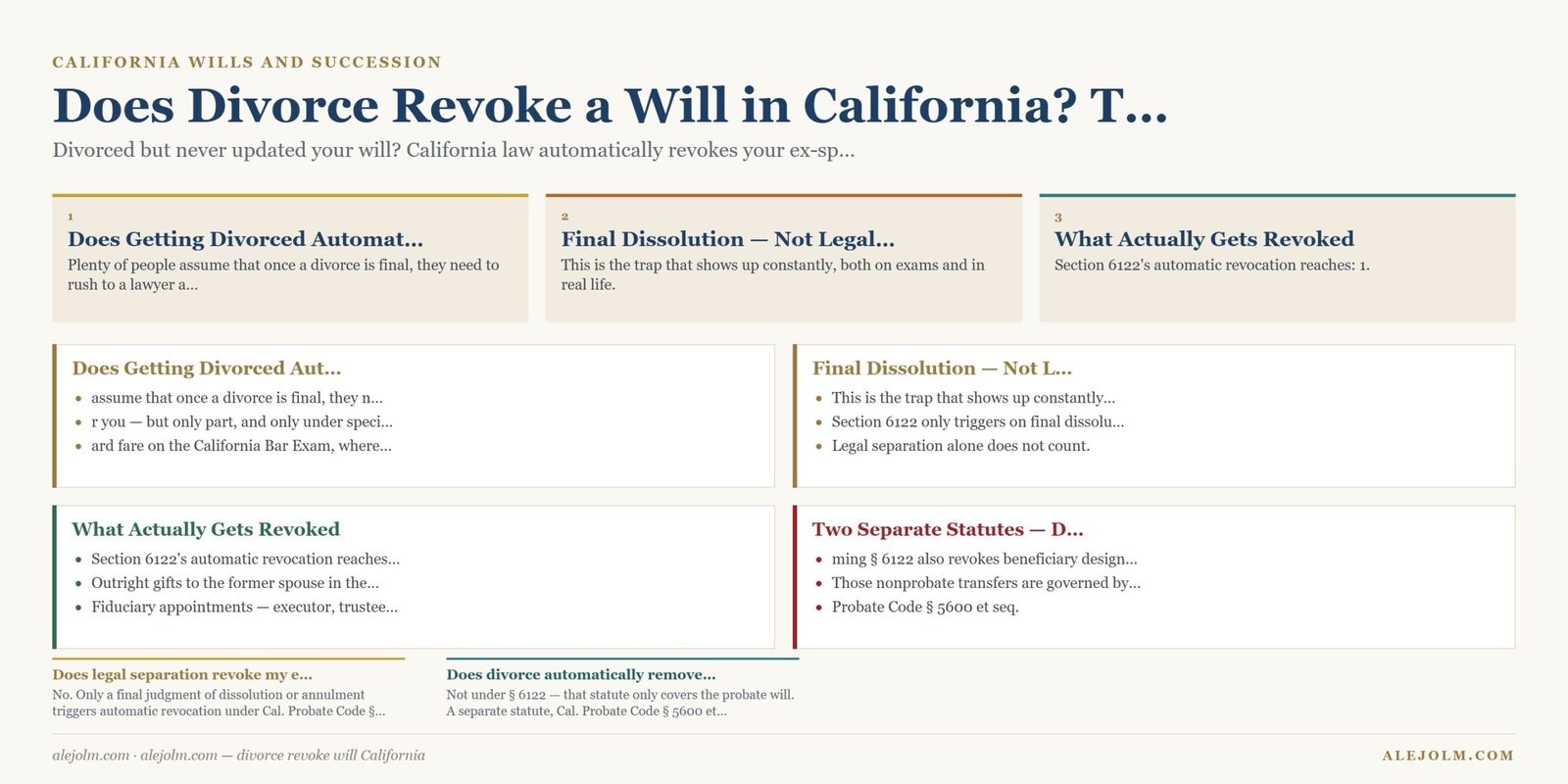
Plenty of people assume that once a divorce is final, they need to rush to a lawyer and rewrite their will to cut out their ex. In California, the law already does part of that work for you — but only part, and only under specific conditions worth understanding before you assume you’re covered. This rule is also standard fare on the California Bar Exam, where the legal-separation trap catches nearly every unprepared candidate.
Cal. Probate Code § 6122 automatically revokes, upon final dissolution or annulment of marriage, any gift or fiduciary appointment (executor, trustee, guardian) that a will gives to the former spouse — without the testator lifting a finger. The former spouse is treated as if they had died before the testator, and alternate provisions take over.
Final Dissolution — Not Legal Separation
This is the trap that shows up constantly, both on exams and in real life. Section 6122 only triggers on final dissolution or annulment. Legal separation alone does not count. A legal separation divides assets and obligations, but the marriage legally continues — so a will naming the still-legally-married spouse remains fully valid.
If a testator dies while legally separated but not yet divorced, the spouse still inherits under the will exactly as written. Only a final judgment of dissolution flips the switch.
What Actually Gets Revoked
Section 6122’s automatic revocation reaches:
- Outright gifts to the former spouse in the will.
- Fiduciary appointments — executor, trustee, guardian, or conservator nominations naming the former spouse.
- Gifts to the former spouse’s relatives who are not also relatives of the testator (for example, the ex-spouse’s children from a previous relationship, if they aren’t also the testator’s children).
What it does not reach: gifts to the testator’s own children, even if those children are also the former spouse’s children. A parent’s divorce doesn’t touch a child’s rights under the will.
Two Separate Statutes — Don’t Conflate Them
A common exam mistake is assuming § 6122 also revokes beneficiary designations on life insurance, retirement accounts, or a revocable trust. It doesn’t. Those nonprobate transfers are governed by a separate statute, Cal. Probate Code § 5600 et seq., which applies the same final-dissolution trigger to will substitutes. The two statutes reach a similar, symmetrical result — but they are legally distinct, and an exam answer should cite both if the facts involve both a will and a nonprobate asset.
| Instrument | Governing Statute | Trigger |
|---|---|---|
| Probate will (gifts and fiduciary nominations) | Cal. Probate Code § 6122 | Final dissolution or annulment |
| Revocable trust, POD/TOD account, other will substitute | Cal. Probate Code § 5600 et seq. | Final dissolution or annulment |
| Life insurance beneficiary designation | Cal. Probate Code § 5600 et seq. | Final dissolution or annulment |
Two Ways the Automatic Rule Doesn’t Apply
There are two important exceptions worth remembering:
- Express survival language. If the will explicitly states the gift to the spouse survives any future divorce (“Notwithstanding any future dissolution of marriage, this gift to S survives and remains effective regardless of marital status”), that language controls, and § 6122 does not revoke the gift.
- Remarriage to the same former spouse. If the couple divorces and later remarries each other, and the will is never changed after the divorce, the original gift is restored. The statute is keyed to the testator’s marital status at death, so remarriage to the same person re-activates a gift that had been revoked.
Worked Example: The Will Nobody Updated
Testator Nancy’s will, signed in 2015, states: “I leave my entire estate to my Spouse, Rob, and I appoint Rob as executor.” Nancy and Rob divorce, with a final judgment entered on March 3, 2023. Nancy never updates her will. She dies in August 2026.
Under § 6122, both the outright gift to Rob and his appointment as executor are automatically revoked as of the final dissolution date. Rob takes nothing under the will and cannot serve as executor. The estate passes under whatever residuary clause exists, or — if none — by intestate succession to Nancy’s heirs, exactly as if Rob had predeceased Nancy.
Now change the facts: Nancy and Rob obtain only a legal separation, never a final divorce judgment, and Nancy dies while the case is still pending. Section 6122 never triggers because there was no final dissolution. Rob still inherits and still serves as executor, per the will’s original terms — even though the couple was living apart and had divided their property.
One more variation: Nancy and Rob divorce, and two years later they remarry each other. Nancy dies without ever updating the 2015 will. Because the will hasn’t changed and Nancy is once again married to Rob at death, the original gift to Rob is restored — he inherits and serves as executor, just as the will originally provided.
Frequently Asked Questions
Does legal separation revoke my ex-spouse’s gift in my will?
No. Only a final judgment of dissolution or annulment triggers automatic revocation under Cal. Probate Code § 6122. Legal separation alone leaves the will’s provisions for the spouse intact.
Does divorce automatically remove my ex as beneficiary on my life insurance policy?
Not under § 6122 — that statute only covers the probate will. A separate statute, Cal. Probate Code § 5600 et seq., applies the same final-dissolution trigger to life insurance, revocable trusts, and other nonprobate transfers.
If I remarry my ex-spouse, does their original gift in my will come back?
Yes, generally — if the will was never changed since the divorce and you later remarry the same former spouse, § 6122’s revocation is undone because it’s tied to your marital status at death.
Key Takeaways
- Cal. Probate Code § 6122 automatically revokes gifts and fiduciary appointments to a former spouse upon final dissolution or annulment — no action required by the testator.
- Legal separation alone does not trigger revocation — only a final dissolution judgment does.
- The rule reaches gifts to the ex-spouse’s non-mutual relatives too, but never touches gifts to the testator’s own children.
- Nonprobate transfers (trusts, POD/TOD accounts, life insurance) are governed by a separate statute, § 5600 et seq. — not § 6122 itself.
- Express survival language in the will and remarriage to the same former spouse are the two ways to override or undo the automatic revocation.
This article is educational and is not legal advice. Consult a licensed California attorney about your situation.
Related guides
- lost or mutilated wills
- advancement in intestate succession
- will reformation and mistake in a will
- intestate succession spouse rights