
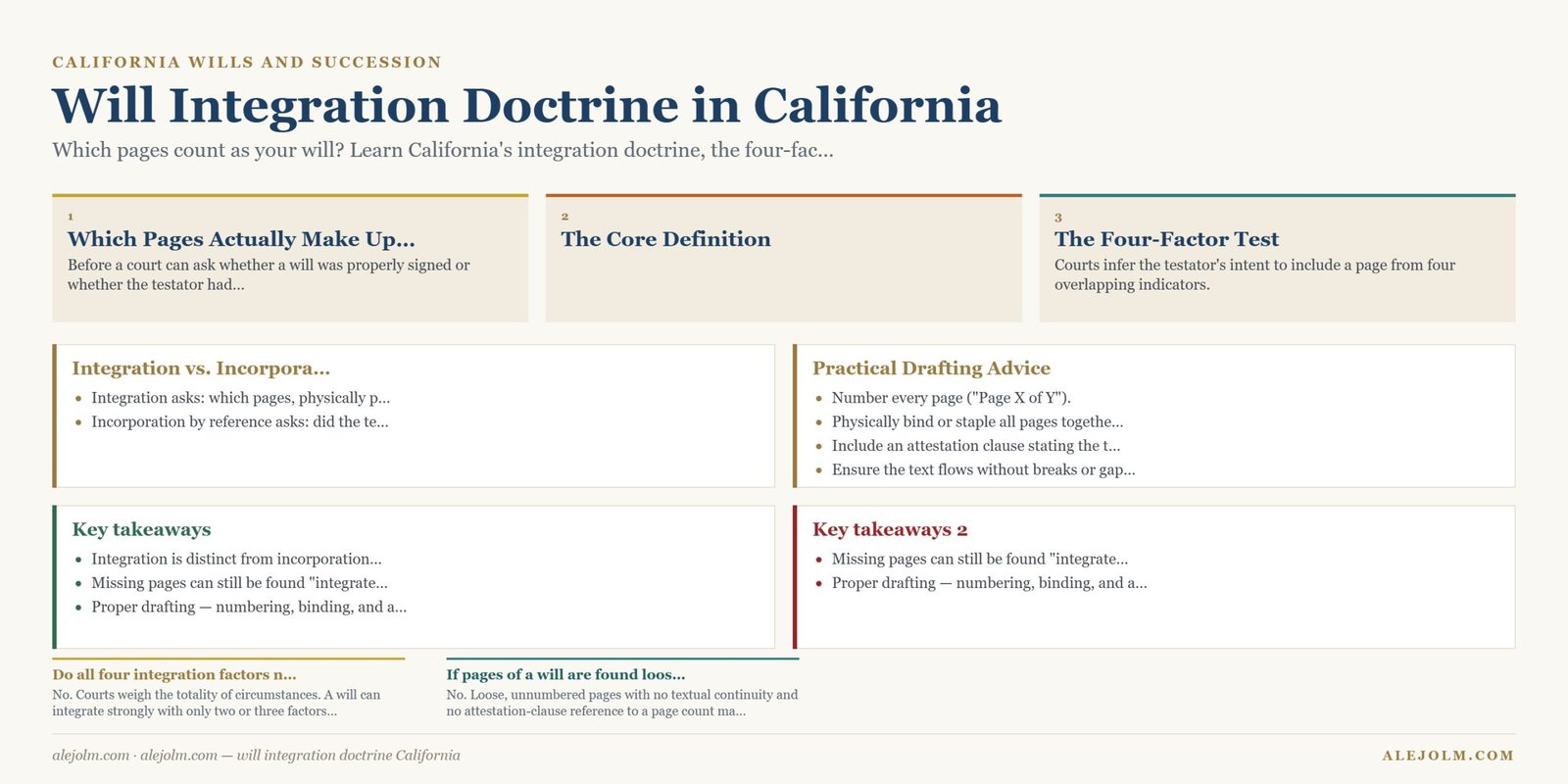
Which Pages Actually Make Up Your Will?
Before a court can ask whether a will was properly signed or whether the testator had capacity, it has to answer a more basic question: which physical pages actually constitute the will? That’s the job of California’s integration doctrine — and it becomes critical the moment pages go missing, get shuffled, or turn up loose in a drawer after someone dies.
Whether you’re prepping for the California Bar Exam or you’re an executor staring at a stack of unstapled papers found in a filing cabinet, understanding integration will save you from a costly mistake.
The Core Definition
Integration is the doctrine that determines which pages of a document were actually present at execution and were intended by the testator to be part of the will. A page is integrated when both conditions are met: it was physically present when the testator signed, and the testator intended it to be part of the will being executed.
The Four-Factor Test
Courts infer the testator’s intent to include a page from four overlapping indicators. No single factor is required — courts weigh the totality of the evidence.
| Factor | What courts look for |
|---|---|
| Physical connection | Staples, paper clips, binding, or other fastening |
| Logical sequence | Text flows naturally from one page to the next, without gaps |
| Attestation clause reference | Language like “this five-page will” naming a page count |
| Consecutive pagination | Numbering such as “Page 1 of 5,” “Page 2 of 5” |
A will with strong indicators across all four factors — stapled, numbered, referenced in the attestation clause — has clear integration. A will missing one or two factors can still integrate if the remaining evidence is strong.
Why This Doctrine Exists
Integration protects against two real risks: pages getting lost or separated after execution, and pages being added after execution by someone trying to alter the testator’s wishes. If a random, unstapled, unnumbered page turns up among a decedent’s papers with no textual connection to the rest of the will and no attestation-clause reference to its existence, a court will likely find it was never integrated — and therefore isn’t part of the will — even if it was found in the same drawer.
A Worked Example
Testator Harold executes a formal will prepared by his attorney. It’s typed on five pages, each numbered “Page 1 of 5” through “Page 5 of 5,” stapled together at the top left corner, with sentences flowing continuously from the end of one page into the beginning of the next. The attestation clause on page five states: “We, the undersigned, attest that this five-page instrument was signed by Harold as his Last Will and Testament.”
Harold dies. When his family opens his safe, they find all five pages, still stapled, in order.
Analysis: Every one of the four integration factors is present — physical connection, logical sequence, pagination, and attestation-clause reference. All five pages integrate as a single will without dispute.
Now change the facts: after Harold’s death, pages 3 and 4 are missing from the file — only pages 1, 2, and 5 are found. Page 2 ends mid-sentence (“…and I give to my daughter the…”) and page 5 picks up (“…remainder of my estate to my son”). Because the attestation clause referenced a five-page will, and the surviving pages show clear textual discontinuity consistent with two missing pages bridging the gap, a court can find that pages 3 and 4 were part of the integrated will — even though they’re now lost. That finding matters enormously, because it affects whether the estate proceeds under a lost-will theory rather than treating pages 1, 2, and 5 as the complete document.
Integration vs. Incorporation by Reference
This is the most commonly confused pairing on the exam, so keep the distinction sharp:
- Integration asks: which pages, physically present now, were intended as part of this executed will document?
- Incorporation by reference asks: did the testator reference and intend to pull in a separate, non-testamentary document — like a property list kept in a safe — into the will’s meaning?
Integration is about the will’s own pages. Incorporation is about bringing in an outside document. A testator can execute a five-page will (all five pages integrated) that also incorporates by reference a separate property memorandum. The five will pages are integrated; the memorandum is incorporated — two different doctrines doing two different jobs.
Integration is also distinct from acts of independent significance, which deals with identifying gifts or beneficiaries by reference to facts outside the will (like “my car” meaning whatever car the testator owns at death), not with which pages make up the document itself.
Practical Drafting Advice
Because integration disputes are entirely avoidable, estate planning attorneys build in redundancy as standard practice:
- Number every page (“Page X of Y”).
- Physically bind or staple all pages together.
- Include an attestation clause stating the total page count.
- Ensure the text flows without breaks or gaps between pages.
Any one of these can be missing without dooming the will, but a document with none of them — loose, unnumbered pages with no logical continuity — invites exactly the kind of dispute integration doctrine exists to resolve.
FAQ
Do all four integration factors need to be present for a will to be valid?
No. Courts weigh the totality of circumstances. A will can integrate strongly with only two or three factors present; the absence of one factor doesn’t automatically defeat integration if the others are strong.
If pages of a will are found loose and unstapled, are they automatically part of the will?
No. Loose, unnumbered pages with no textual continuity and no attestation-clause reference to a page count may not be found integrated, even if discovered together with the rest of the will.
Is integration only relevant when pages are missing?
No. Integration is a threshold issue that applies to every multi-page will, even when all pages appear present and in order, because a court must still determine which pages constitute the executed document.
Key Takeaways
- Integration determines which physical pages constitute the executed will, based on the testator’s intent at the moment of signing.
- Courts weigh four factors: physical connection, logical sequence, attestation-clause reference, and consecutive pagination — no single factor is mandatory.
- Integration is distinct from incorporation by reference (which imports a separate document) and from acts of independent significance (which identifies gifts by external facts).
- Missing pages can still be found “integrated” if surviving text and attestation-clause language support their prior inclusion.
- Proper drafting — numbering, binding, and an explicit page-count attestation clause — prevents integration disputes entirely.
This article is educational and is not legal advice. Consult a licensed California attorney about your situation.
Related guides
- California’s harmless error rule for wills
- California’s Section 6132 personal property memorandum
- pour-over wills in California
- present testamentary intent