
What Is Rule 8.5’s Choice-of-Law Test?
Rule 8.5 governs a scenario that shows up constantly on the MPRE and the California Bar Exam: a lawyer licensed in one state does something that touches another state. Which state’s ethics rules apply, and which state can discipline the lawyer?
Disciplinary authority in California follows the lawyer, not the location. A California-licensed lawyer is subject to California’s disciplinary authority for conduct anywhere, and simultaneously subject to discipline in any other jurisdiction where she provides or offers to provide legal services — the two are not mutually exclusive.
The Rare Rule Where California and the ABA Agree
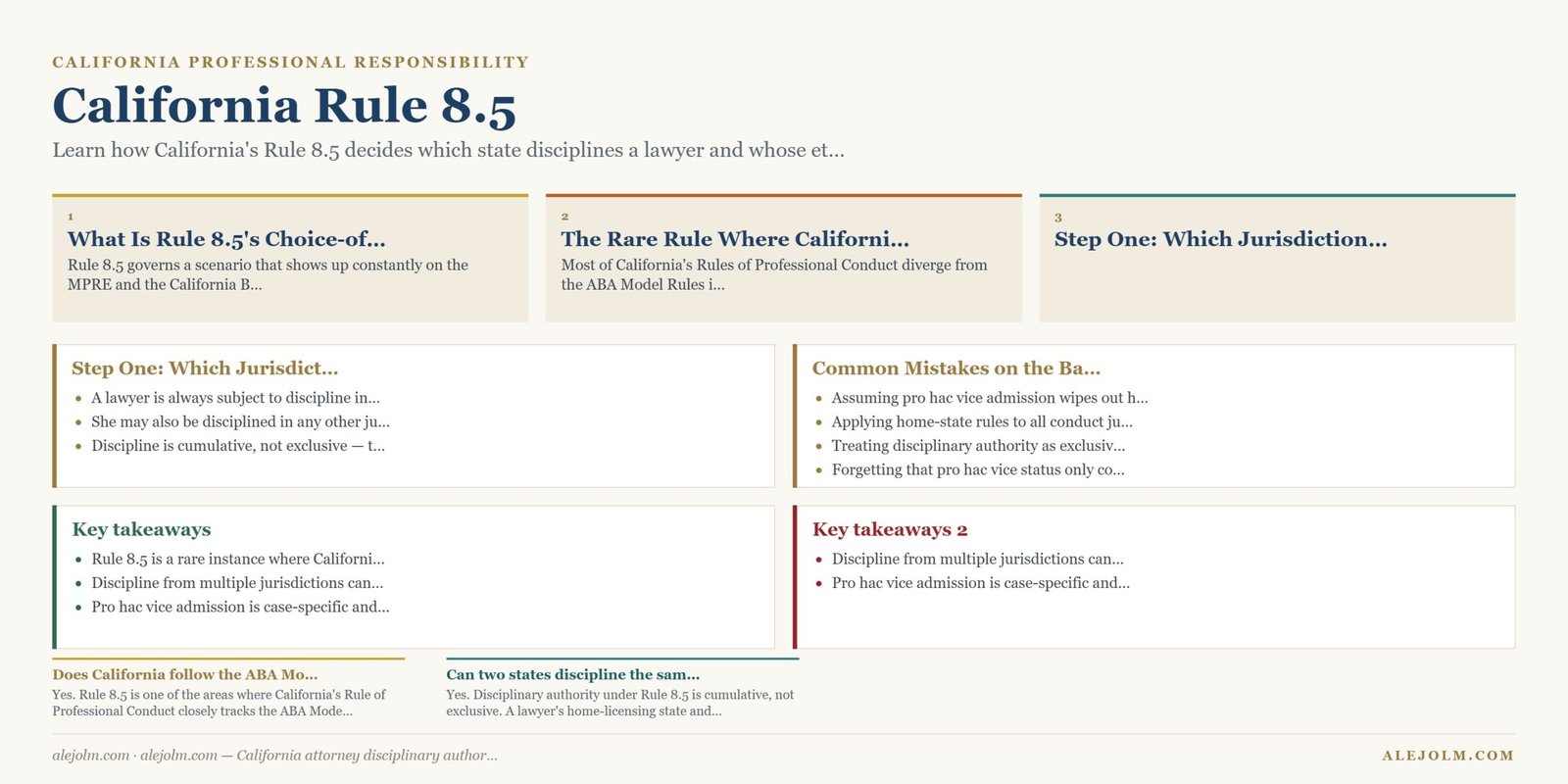
Most of California’s Rules of Professional Conduct diverge from the ABA Model Rules in at least small but testable ways. Rule 8.5 is one of the exceptions: California’s version substantially tracks the ABA model, which is itself worth noticing, because bar examiners like to test the handful of areas where the “California is different” pattern doesn’t hold.
That means for choice-of-law and disciplinary-authority questions, you can generally apply the same two-step analysis regardless of whether the question is framed as an MPRE question under the ABA rules or a California Bar Exam essay under the CRPC.
Step One: Which Jurisdiction Disciplines the Lawyer?
- A lawyer is always subject to discipline in the state where she is licensed, regardless of where the conduct occurred.
- She may also be disciplined in any other jurisdiction where she provides or offers to provide legal services — including through temporary admission like pro hac vice.
- Discipline is cumulative, not exclusive — two, three, or more jurisdictions can independently discipline the same lawyer for the same conduct.
Step Two: Which Jurisdiction’s Rules Apply to the Conduct?
Rule 8.5 splits the choice-of-law analysis into two lanes:
- Matters pending before a tribunal. The rules of the jurisdiction where the tribunal sits govern, unless that tribunal’s own rules say otherwise — even if the lawyer is only there temporarily on a pro hac vice basis.
- Everything else (transactional or non-litigation conduct). The rules of the jurisdiction where the conduct occurred apply, unless the predominant effect of the conduct is felt in a different jurisdiction — in which case that jurisdiction’s rules control instead.
Comparison Table: Litigation Conduct vs. Transactional Conduct
| Scenario | Governing rules | Why |
|---|---|---|
| Lawyer appears pro hac vice in a New York trial | New York’s rules | Matter is pending before a New York tribunal |
| California lawyer negotiates an Arizona real-estate deal entirely by phone and email from a Los Angeles office | Arizona’s rules | Predominant effect of the transaction is in Arizona |
| California lawyer commits misconduct while working in her New York office (dual-licensed CA/NY) | Both states may discipline independently | Disciplinary authority is cumulative, not exclusive |
Worked Example: Pro Hac Vice Doesn’t Mean Immunity Back Home
Assume David is licensed only in California but obtains pro hac vice admission to represent a client in a single Nevada state-court trial. During cross-examination, David uses tactics that Nevada’s fairness-in-litigation rule prohibits, even though California’s equivalent rule would tolerate more aggressive questioning.
Because the matter was pending before a Nevada tribunal, Nevada’s rules govern David’s trial conduct, and Nevada can discipline him for violating them. But California — as David’s home licensing jurisdiction — retains independent authority to investigate and discipline the same conduct under California’s rules. David can’t argue that pro hac vice admission shields him from California discipline; the two states’ authority runs on separate, parallel tracks.
Worked Example: The Predominant-Effect Test in a Transaction
Now assume the same David, still California-licensed, negotiates the sale of Arizona real property entirely from his Los Angeles office — calls, emails, video conferences, no in-person travel to Arizona, and no litigation involved. The client is based in Arizona, the property is in Arizona, and the deal’s entire economic effect lands in Arizona.
Even though David never left California, Arizona’s rules govern this transaction, because the predominant effect of his conduct occurred there. The fact that he happened to be sitting in his Los Angeles office is irrelevant once the predominant-effect test points somewhere else.
Common Mistakes on the Bar Exam
- Assuming pro hac vice admission wipes out home-state discipline for the same conduct.
- Applying home-state rules to all conduct just because the lawyer is physically located there, ignoring the predominant-effect test for non-litigation matters.
- Treating disciplinary authority as exclusive to one jurisdiction, rather than cumulative.
- Forgetting that pro hac vice status only covers the specific case it was granted for — handling unrelated matters in that state risks an unauthorized-practice problem layered on top of the Rule 8.5 analysis.
FAQ
Does California follow the ABA Model Rule on choice of law for discipline?
Yes. Rule 8.5 is one of the areas where California’s Rule of Professional Conduct closely tracks the ABA Model Rule, unlike many other CRPC provisions that diverge substantially.
Can two states discipline the same lawyer for the same conduct?
Yes. Disciplinary authority under Rule 8.5 is cumulative, not exclusive. A lawyer’s home-licensing state and any state where she practices, including on a pro hac vice basis, can each independently pursue discipline.
What test applies to non-litigation conduct that touches multiple states?
The “predominant effect” test: the rules of the jurisdiction where the conduct occurred apply, unless the predominant effect of that conduct is felt in a different jurisdiction, in which case that jurisdiction’s rules control.
Key Takeaways
- California is always a source of disciplinary authority over a California-licensed lawyer, no matter where the misconduct occurred.
- For litigation, the rules of the tribunal’s jurisdiction govern; for everything else, it’s the location of the conduct — or, if different, wherever the predominant effect lands.
- Rule 8.5 is a rare instance where California’s rule closely mirrors the ABA Model Rule.
- Discipline from multiple jurisdictions can stack; none of them exclude the others.
- Pro hac vice admission is case-specific and does not create ongoing authorization to practice in that state.
This article is educational and is not legal advice. Consult a licensed California attorney about your situation.
Related guides
- California’s mandatory self-reporting duty under Section 6068(o)
- duties owed to prospective clients under Rule 1.18
- California’s rules on paying witnesses under Rule 3.4