
When One Settlement Covers Several Clients, One Signature Isn’t Enough
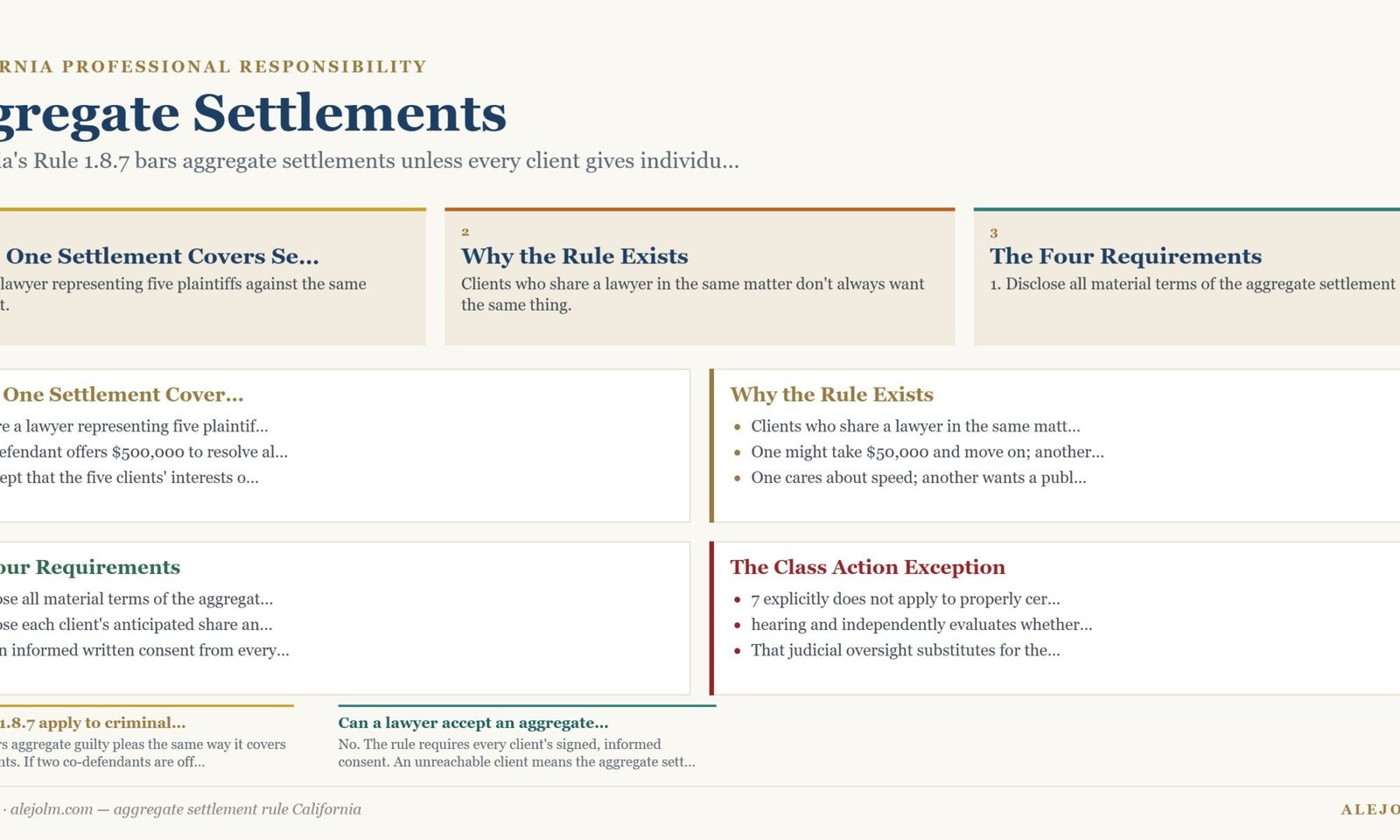
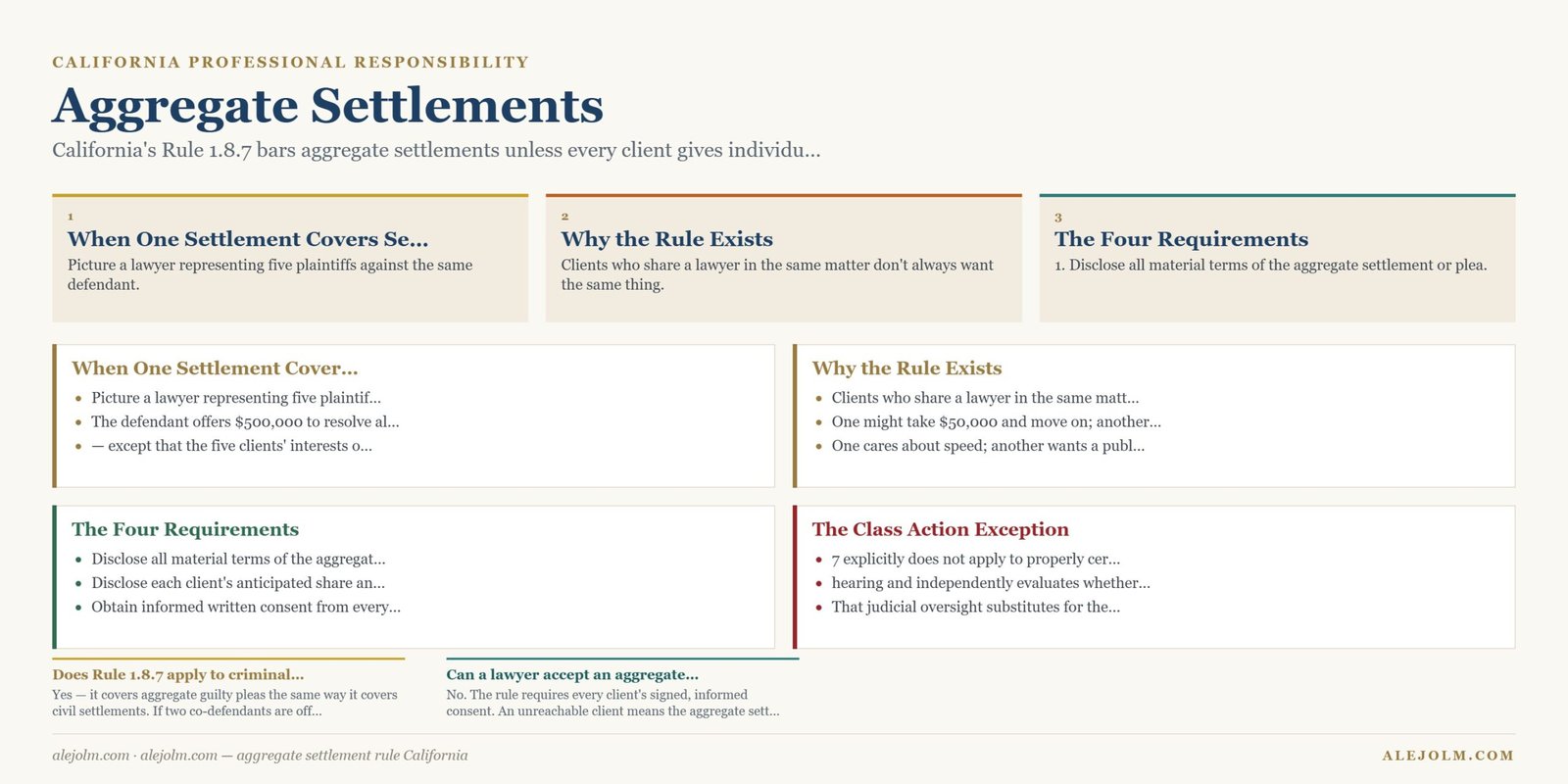
Picture a lawyer representing five plaintiffs against the same defendant. The defendant offers $500,000 to resolve all five claims at once. That’s an efficient outcome for everyone — except that the five clients’ interests over how to split that money are not the same, and California Rule 1.8.7 exists precisely because a lawyer cannot make that call for them.
California Rule 1.8.7 (paralleling ABA Model Rule 1.8(g)) prohibits a lawyer representing multiple clients from entering an aggregate settlement, or an aggregate guilty plea in a criminal case, unless the lawyer discloses all material terms, discloses each client’s anticipated share, and obtains informed written consent signed by every single client. Not a majority. Every client.
Why the Rule Exists
Clients who share a lawyer in the same matter don’t always want the same thing. One might take $50,000 and move on; another might hold out for $100,000. One cares about speed; another wants a public vindication that only trial can deliver. When a global settlement forces these preferences into a single package, the lawyer’s duty of loyalty to each client individually is under strain — which is exactly why the rule demands individualized, informed consent rather than a group sign-off.
The Four Requirements
- Disclose all material terms of the aggregate settlement or plea.
- Disclose each client’s anticipated share and position relative to the others.
- Obtain informed written consent from every client — not a majority, not the lawyer’s own certification.
- The client, personally, signs. Not an agent, not a family member, not the lawyer.
The Class Action Exception
Rule 1.8.7 explicitly does not apply to properly certified class action settlements. Under Federal Rule of Civil Procedure 23 (and California’s equivalent), a court holds a fairness hearing and independently evaluates whether the settlement is adequate and reasonable for the class as a whole. That judicial oversight substitutes for the individual written consent Rule 1.8.7 would otherwise require. A lawyer representing 500 class members in a mass-tort settlement does not need 500 signatures — the court’s approval covers the group.
| Scenario | Individual Consent Required? | Why |
|---|---|---|
| 500-member certified class action | No | Court’s Rule 23 fairness hearing substitutes for consent |
| 5 individual plaintiffs, joint global settlement | Yes — all 5 | Not a certified class; each is a separate client |
| 2 co-defendants offered a single unified plea | Yes — both | Package deal triggers the aggregate-plea rule |
| 2 co-defendants offered separate, individual plea terms | No — decide independently | Not an aggregate plea; each defendant chooses alone |
Worked Example: The Deficient Consent Form
A California lawyer represents three clients — Priya, Jordan, and Sam — in related personal injury claims against the same trucking company. The company offers $300,000 to resolve all three claims together. The lawyer drafts a one-line consent form: “We agree to settle for $300,000 total,” and gets all three signatures.
That consent is not valid under Rule 1.8.7. It discloses a lump sum but never tells Priya, Jordan, or Sam what they individually receive, or why. To fix it, the lawyer must go back with a real allocation: Priya receives $150,000 because her injuries were most severe, Jordan receives $100,000, and Sam receives $50,000. Each client needs to see this specific breakdown, understand the trade-offs (Priya getting more necessarily means less for the others out of a fixed pool), and be told they’re entitled to consult independent counsel before signing. Only then does a signature satisfy the rule. Getting four out of five signatures on a similar deal — even if the fifth client is unreachable — is not a substitute; the settlement cannot close without unanimous, informed, individual consent.
Common Mistakes
- Settling for “substantial agreement” instead of unanimous consent. Four of five clients agreeing is not enough; Rule 1.8.7 requires every client.
- Using vague, lump-sum language. A consent form must show each client’s specific share, not just the total pot.
- Letting someone else sign for the client. The client must sign personally unless a properly authorized agent has explicit settlement authority.
- Confusing “several plaintiffs, one lawyer” with a certified class action. The class action exception applies only to court-supervised certified classes, not to any group of clients who happen to share counsel.
- Failing to mention the right to independent counsel. Clients should be told they may consult a separate lawyer to review the aggregate deal before signing.
FAQ
Does Rule 1.8.7 apply to criminal cases?
Yes — it covers aggregate guilty pleas the same way it covers civil settlements. If two co-defendants are offered one unified plea package, both must give informed written consent. Separate, individually negotiated pleas for each defendant are not “aggregate” and fall outside the rule.
Can a lawyer accept an aggregate settlement if one client can’t be reached for a signature?
No. The rule requires every client’s signed, informed consent. An unreachable client means the aggregate settlement cannot be finalized as to anyone until consent is obtained or the structure changes.
How is Rule 1.8.7 different from the general conflict-of-interest rule?
Rule 1.7 addresses conflicts generally, including when multiple clients’ interests diverge. Rule 1.8.7 is a specific safeguard that applies once an aggregate settlement or plea is actually on the table, and both rules can require consent simultaneously.
Key Takeaways
- Every client in an aggregate settlement or plea must give informed, individual, written consent — majority agreement is not enough.
- Consent must disclose each client’s specific share and any material trade-offs between clients.
- Only the client may sign; an agent or family member cannot sign on the client’s behalf.
- Certified class action settlements are the one major exception, because a court’s fairness hearing substitutes for individual consent.
- Rule 1.8.7 works alongside, not instead of, the general concurrent-conflict rule.
This article is educational and is not legal advice. Consult a licensed California attorney about your situation.
Related guides
- California’s written consent rule for third-party payers
- conflicts of interest
- California’s undue influence rule for gifts from clients