
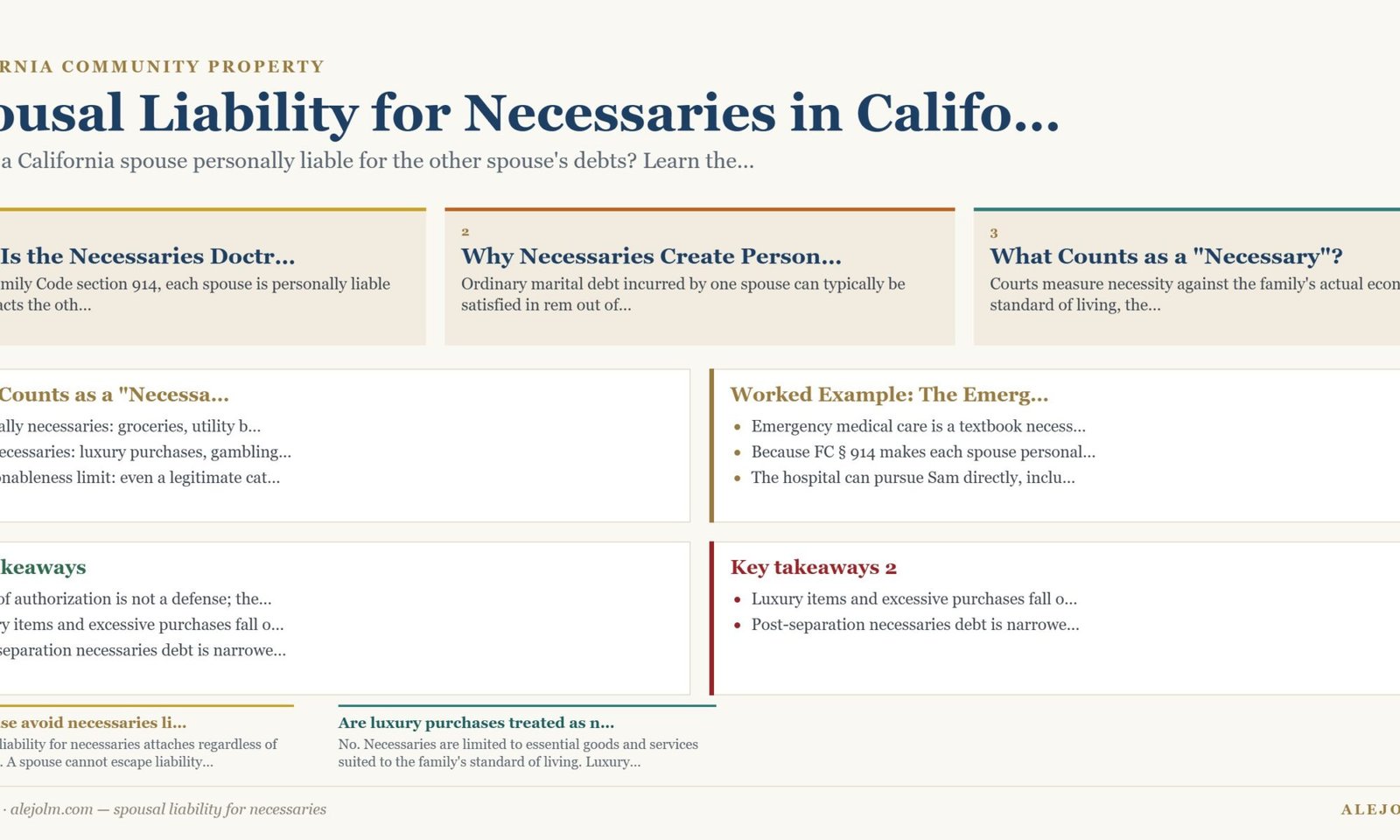
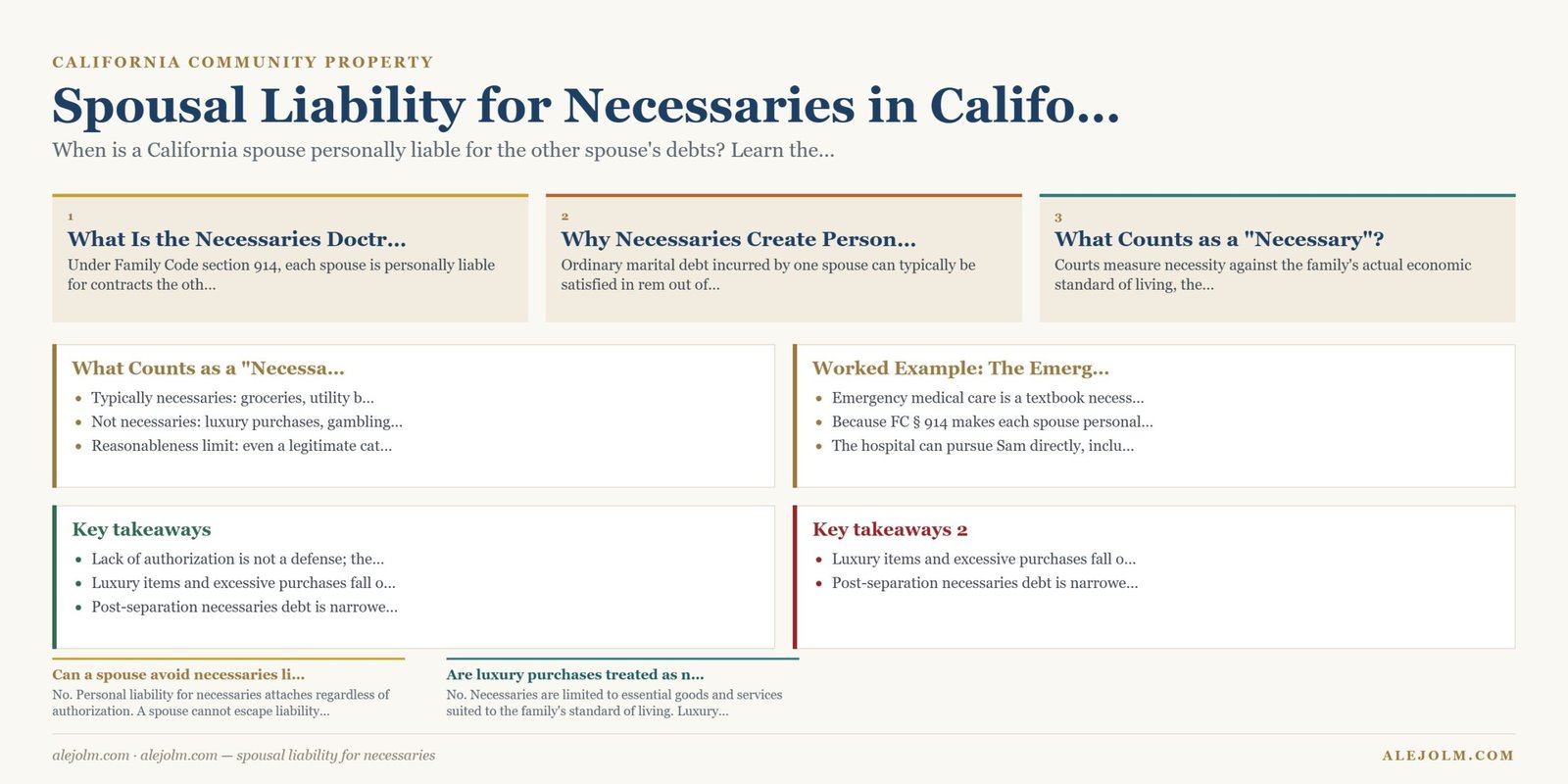
What Is the Necessaries Doctrine in California Family Law?
Under Family Code section 914, each spouse is personally liable for contracts the other spouse makes to obtain necessaries — essential goods and services suited to the family’s standard of living, such as food, shelter, clothing, and medical care. This is the one significant exception in California community property law where a debt creates personal liability against a spouse who never agreed to it, exposing that spouse’s entire estate rather than just a specific asset.
For California Bar Exam purposes, necessaries liability is unusual precisely because most of community property law is about characterizing assets, not about imposing personal liability on an uninvolved person. When a fact pattern mentions medical bills, groceries, or emergency housing, think necessaries first.
Why Necessaries Create Personal, Not Just In Rem, Liability
Ordinary marital debt incurred by one spouse can typically be satisfied in rem out of community property and the debtor spouse’s separate property, while the non-debtor spouse’s separate property stays protected. Necessaries flip part of that protection:
| Type of debt | Non-debtor spouse’s exposure |
|---|---|
| Ordinary marital debt | Community property and debtor’s SP reachable; non-debtor’s SP protected |
| Necessaries debt (FC § 914) | Non-debtor spouse is personally liable, exposing their own separate property too |
The non-debtor spouse cannot escape this liability simply by arguing they never authorized the purchase. A creditor can pursue either spouse personally for a necessaries debt.
What Counts as a “Necessary”?
Courts measure necessity against the family’s actual economic standard of living, then apply a reasonableness ceiling:
- Typically necessaries: groceries, utility bills, rent or mortgage payments, medical and dental care, insurance, and in some contexts children’s education.
- Not necessaries: luxury purchases, gambling losses, and other discretionary or frivolous spending.
- Reasonableness limit: even a legitimate category (like medical care) loses necessaries status if the quantity or quality purchased is excessive relative to the family’s means.
The creditor bears the burden of showing the goods or services were necessaries — not luxuries — provided in good faith, and appropriate to the family’s standard of living.
How Necessaries Liability Differs From Ordinary Marital Debt
Necessaries liability is personal; ordinary marital debt liability is in rem. That distinction changes what a creditor can seize:
- For ordinary marital debt, a creditor generally reaches community property, then the debtor spouse’s separate property.
- For necessaries, a creditor can go straight after the non-debtor spouse personally — including that spouse’s separate property — because FC § 914 makes both spouses personally responsible.
Post-Separation Necessaries Are Narrower
Once spouses separate, the necessaries doctrine tightens. Debts incurred after separation are limited to bare “necessities of life” — essentially basic sustenance — rather than the broader family standard-of-living test used during the marriage. And instead of an automatic 50/50 split, FC § 2623(b) lets the divorce court assign post-separation necessaries debt based on each spouse’s need and ability to pay.
Worked Example: The Emergency Surgery
Priya undergoes emergency surgery costing $50,000 while married to Sam. Sam had no idea Priya needed surgery and never signed anything with the hospital. The hospital bill arrives addressed to both spouses.
- Emergency medical care is a textbook necessary — it’s suited to the family’s standard of living and was reasonably required.
- Because FC § 914 makes each spouse personally liable for necessaries the other spouse obtains, Sam is personally liable for the $50,000 bill, even though he never authorized the surgery.
- The hospital can pursue Sam directly, including his separate property, not merely community assets.
Contrast that with a second scenario: instead of surgery, Priya buys $100,000 in jewelry without telling Sam. Jewelry is a luxury item, not suited to ordinary family needs. If the jeweler sues both spouses for the unpaid balance, Sam is not personally liable under FC § 914 — though community property may still be reachable in rem if the debt otherwise qualifies as ordinary marital debt.
Common Mistakes Bar Candidates Make
A frequent wrong answer treats every expense incurred “on behalf of” the family as automatically triggering personal liability for both spouses. That overstates the rule. Personal liability for necessaries is limited to essential goods and services; luxuries, entertainment, and non-essential purchases do not create personal liability for the non-purchasing spouse.
Another mistake is forgetting that the necessaries standard narrows sharply after separation, and that post-separation necessaries debt is allocated by need and ability to pay under FC § 2623(b) rather than a flat 50/50 split.
FAQ
Can a spouse avoid necessaries liability by proving they never authorized the purchase?
No. Personal liability for necessaries attaches regardless of authorization. A spouse cannot escape liability simply by showing they didn’t know about or approve the purchase.
Are luxury purchases treated as necessaries under FC § 914?
No. Necessaries are limited to essential goods and services suited to the family’s standard of living. Luxury items, gambling debts, and frivolous purchases fall outside the doctrine.
Does the necessaries rule work the same way after spouses separate?
No. After separation, necessaries narrow to bare necessities of life, and the divorce court allocates that debt based on each spouse’s need and ability to pay under FC § 2623(b), not an automatic even split.
Key Takeaways
- FC § 914 makes each spouse personally liable for necessaries the other spouse obtains — food, shelter, medical care, and similar essentials.
- Necessaries liability is personal, exposing the non-debtor spouse’s own assets, unlike ordinary marital debt, which is typically in rem only.
- Lack of authorization is not a defense; the creditor need only show the item was a genuine necessary provided in good faith.
- Luxury items and excessive purchases fall outside the necessaries doctrine.
- Post-separation necessaries debt is narrower and allocated by need and ability to pay, not automatic 50/50 division.
This article is educational and is not legal advice. Consult a licensed California attorney about your situation.
Related guides
- community property creditor rights
- spousal tort liability satisfaction
- divorce debt allocation
- community property presumptions